How to Tell if a Diamond Is Real (and Which Tests Actually Work)
Most home tests for a real diamond prove very little. Here's what each one can and can't tell you, according to GIA, and how to check a grading report yourself.

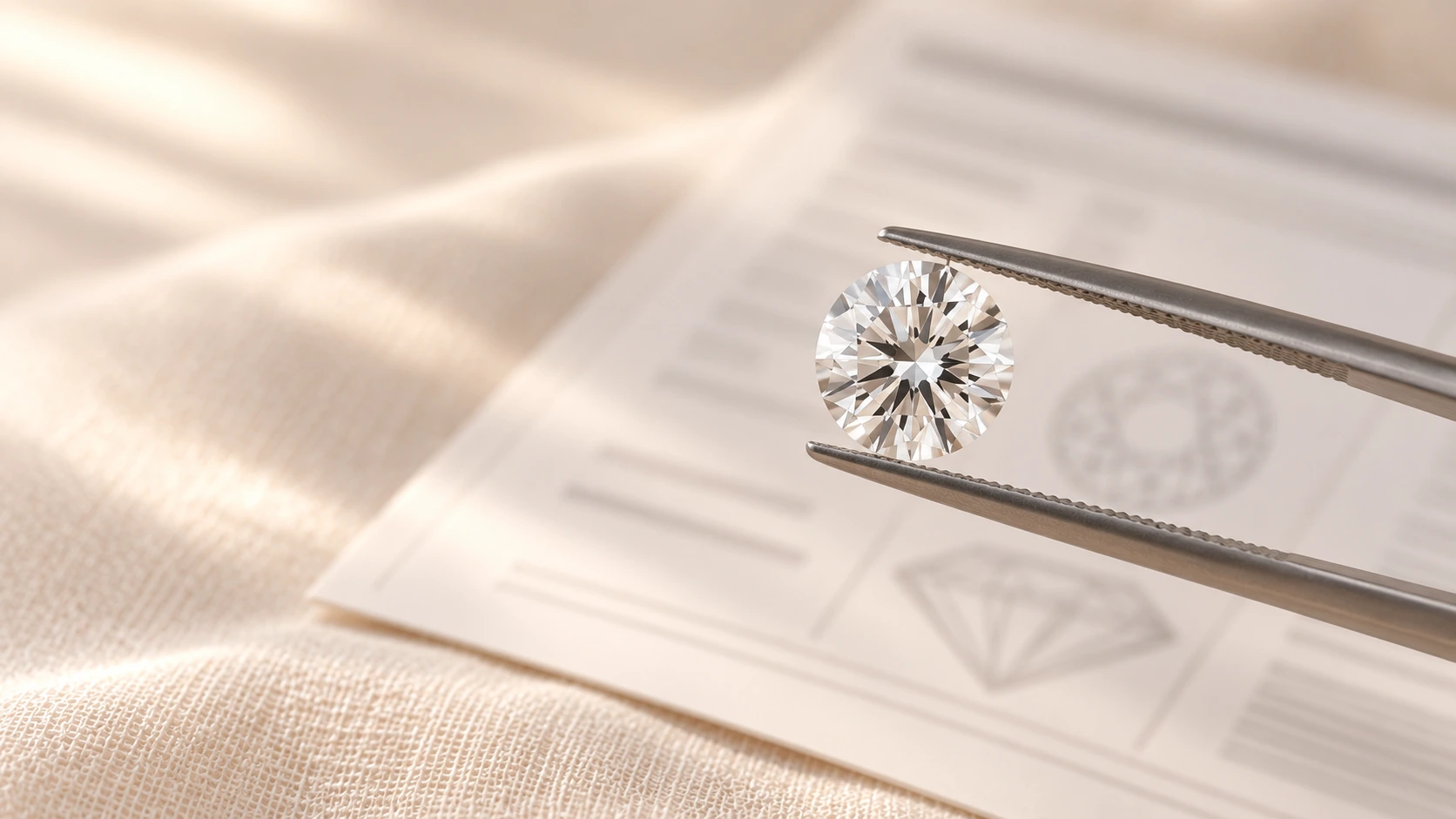
The only reliable way to tell if a diamond is real is to check it against its grading report, or to have a gemologist test it. Most of the home tests you'll find online prove very little. GIA, the gem institute that created the modern diamond grading system, calls several of them unreliable, and one of them destructive.
Home tests can still catch an obvious fake. They can't separate a lab grown diamond from a mined one, because both are diamond. Here is what each common test can really tell you.
| Test | What it can catch | GIA's verdict | Tells lab grown from mined? |
|---|---|---|---|
| Check the grading report | Any imitation, if the stone matches the report | The most reliable check you can do | Yes — the report says so |
| A gemologist or lab | Everything | The definitive answer | Yes |
| Diamond tester | Glass and cubic zirconia | Basic heat testers read moissanite as diamond | No |
| Loupe (10× magnifier) | Moissanite's doubled facet edges, if you know what to look for | Hard for most people to use | No |
| Fog test | Nothing reliably | "Cannot be replicated with consistent results" | No |
| Read-through test | Some imitations, some of the time | Misleading for the inexperienced | No |
| Metal stamp | A cheap setting | "Not a definitive clue" | No |
| Sparkle | Nothing | Moissanite, cubic zirconia and zircon all sparkle | No |
| UV light | Nothing | Only 25–35% of diamonds glow | No |
| Water test | Nothing | Almost everything sinks | No |
| Scratch test | — | "Destructive… should never be used" | No |
The home tests that don't work
The fog test. Breathe on the stone and a diamond is supposed to clear at once. GIA says the result can't be repeated consistently, and nobody agrees how long to breathe or what counts as "at once".
Sparkle. A diamond sparkles, but so does almost any well-cut clear gem. Moissanite actually shows more colored flashes than diamond does.
The read-through test. Lay a loose stone face down on printed text; you shouldn't be able to read through a diamond. It works only on loose stones of certain cuts, and GIA calls it confusing and misleading for anyone without training.
UV light. Some diamonds glow blue under ultraviolet light, but in a GIA study of more than 26,000 diamonds, only about 25 to 35% did. Some lab grown diamonds glow too. A glow, or no glow, proves nothing either way.
The water test. A loose diamond sinks in water because it's far denser. Most imitations sink too, so the test separates almost nothing.
The metal stamp and "sharp edges". A diamond set in cheap metal is a warning sign, but GIA says metal alone isn't proof. And worn, chipped facet edges can happen on any gem, real or not.
Scratching glass or sandpaper. Don't. GIA calls it destructive. Diamond is the hardest natural material, but moissanite comes a close second, so a scratch proves little and can chip the stone you're testing.
What a diamond tester can and can't tell you
Most handheld testers measure how fast a stone draws heat away. Diamond does that extremely well, so glass and cubic zirconia fail the test. Moissanite doesn't. As long ago as 1997, GIA's research journal reported that thermal probes react to moissanite as if it were diamond. Testers that add a second check made for moissanite exist, so ask which kind a jeweler is using.
No tester can tell a lab grown diamond from a mined one. A lab grown diamond is a diamond, so it passes exactly as a mined diamond would. GIA is direct about it: you can't spot a lab grown diamond through a loupe, and only laboratory testing can tell them apart. Where the two really differ is price and resale value, which we compare in are lab grown diamonds worth it.

How to check a grading report yourself
A grading report from an independent lab is the strongest proof you can check at home. Here's how:
- Find the report number. It's printed on the report, and many graded diamonds also carry it laser-inscribed on the girdle, the thin outer edge, where you can read it with a 10× loupe.
- Look it up. GIA's Report Check and IGI's Verify Your Report tools show the lab's own record for that number.
- Match the stone to the record. Check the shape, carat weight and measurements, not just the number. The record also says whether the diamond is lab grown.
That last step matters. In 2020, GIA's lab found a moissanite carrying an inscription that copied the report number of a genuine GIA-graded diamond of the same weight. The number checked out; the stone didn't. If anything doesn't match, or the stone is valuable to you, pay for a lab or an independent gemologist to test it.
Where we stand
We sell lab grown diamonds only, and every one comes with an IGI or GIA report, so you can run the check above on any stone we sell. It also means we know exactly how little the home tests prove: our diamonds pass every one of them, the same as mined diamonds do. If you need to know whether a stone was mined, no home test or ordinary tester will tell you. Only the report or a lab will. You can see how grading works on our GIA certified lab grown diamonds, or browse all our lab grown diamonds.
Common questions
Yes, a diamond can scratch glass, but that doesn't make it a useful test. Moissanite is almost as hard and scratches glass too, and so do some other imitations. GIA calls scratch tests destructive, because pressing a stone hard against glass or sandpaper can chip its edges. Use the grading report or a gemologist instead.
Start with any paperwork: larger stones often come with a grading report you can look up. Small earring diamonds usually don't have reports, so a jeweler with a tester that also checks for moissanite is the practical option. A metal stamp such as 14K on the post is a good sign, but on its own it doesn't prove the stones.
It can happen, though it's rare. GIA once found a moissanite inscribed with a copied report number that belonged to a genuine diamond. That's why you should match the stone's shape, weight and measurements to the lab's online record, not just the number. If anything doesn't line up, have the stone tested by a lab.
Yes. US rules define a diamond by what it is: a mineral made of essentially pure carbon, crystallized in the cubic system, with a hardness of 10 and a refractive index of 2.42. A lab grown diamond meets that definition. What differs is where it formed, and sellers must put "laboratory-grown" or a similar phrase right next to the word "diamond" so you always know.
No. A diamond doesn't make its own light; it only returns the light that falls on it. A few diamonds do keep glowing for a short time after a UV lamp is switched off, which is called phosphorescence. The famous Hope diamond glows red this way. That afterglow is rare in mined diamonds but common in some lab grown ones.
Yes, though they're very rare. Most natural blue diamonds get their color from tiny traces of boron, and the Hope diamond is one of them. Blue diamonds are also grown in labs, and some diamonds are turned blue by treatment, such as irradiation. A grading report tells you which it is: natural color, treated color or lab grown.