Lab Grown Diamonds Pass Diamond Testers. So How Does Anyone Tell?
Yes, lab grown diamonds pass a diamond tester. Here's which tools can tell them from mined diamonds, what a jeweler can check, and what's inscribed on the stone.
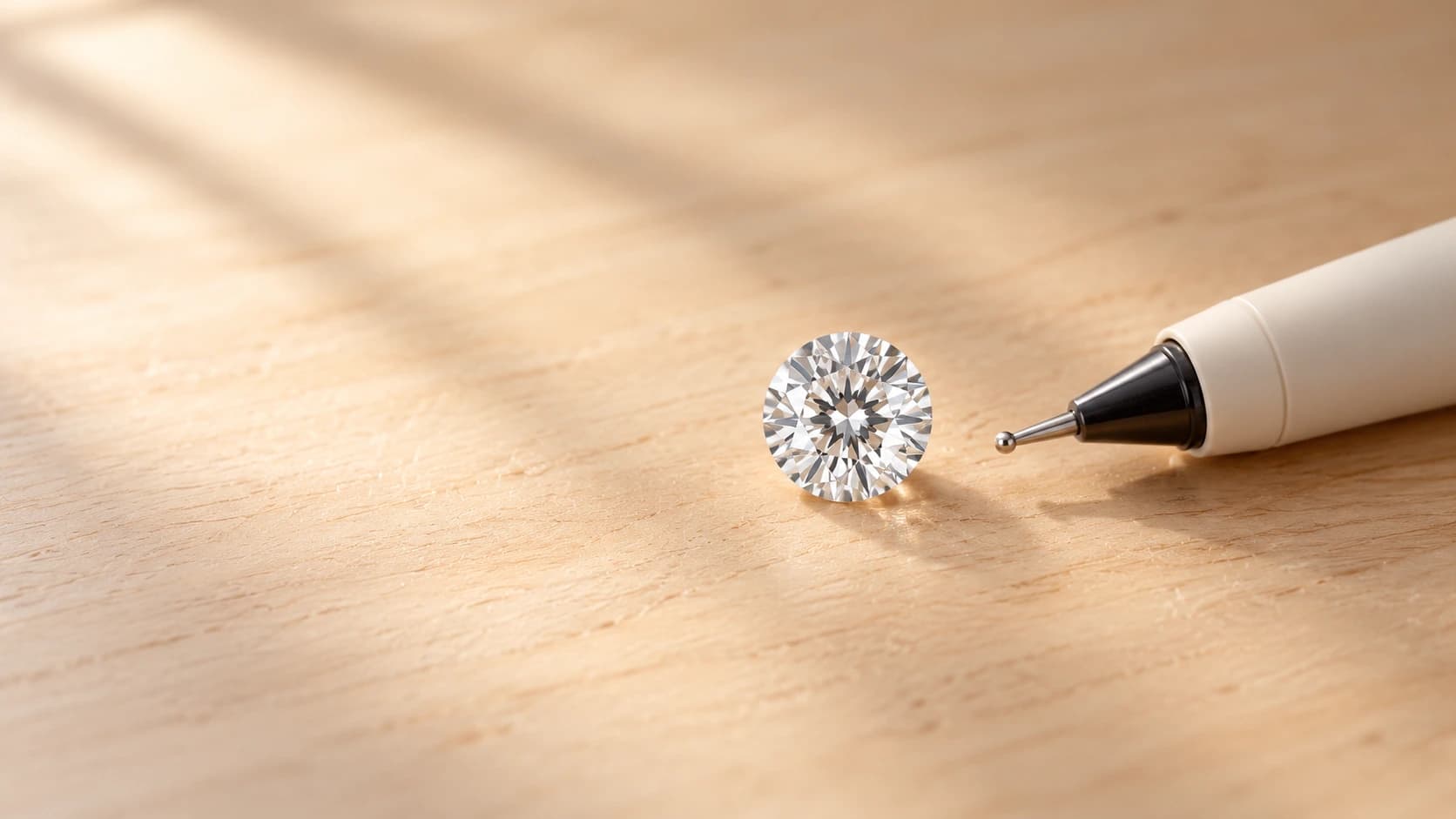
Do lab grown diamonds pass a diamond tester? Yes. A standard tester reads a lab grown diamond as diamond, because that's what it is: the same carbon crystal as a diamond that was mined. We sell only lab grown diamonds, and every one of them would pass.
So a "diamond" reading tells you the stone isn't glass or cubic zirconia. It says nothing about where the diamond came from. Three things can: a screening machine, a gem lab, and the inscription and report that came with the stone. Below, each tool rated on that one question, then what to check before you buy or sell.
What can tell a lab grown diamond from a mined one
| Tool | Can it tell lab grown from mined? | Why |
|---|---|---|
| Handheld diamond tester | No | It checks how fast the stone draws heat away. All diamond does this the same way. |
| Tester with a moissanite check | No, and now and then it calls a lab grown diamond moissanite | Its electrical check can be fooled by lab grown diamonds that contain boron |
| 10× loupe | No | Under magnification, the two look the same |
| UV lamp at home | No | A long afterglow is common in one kind of lab grown diamond, but it's a hint, not proof |
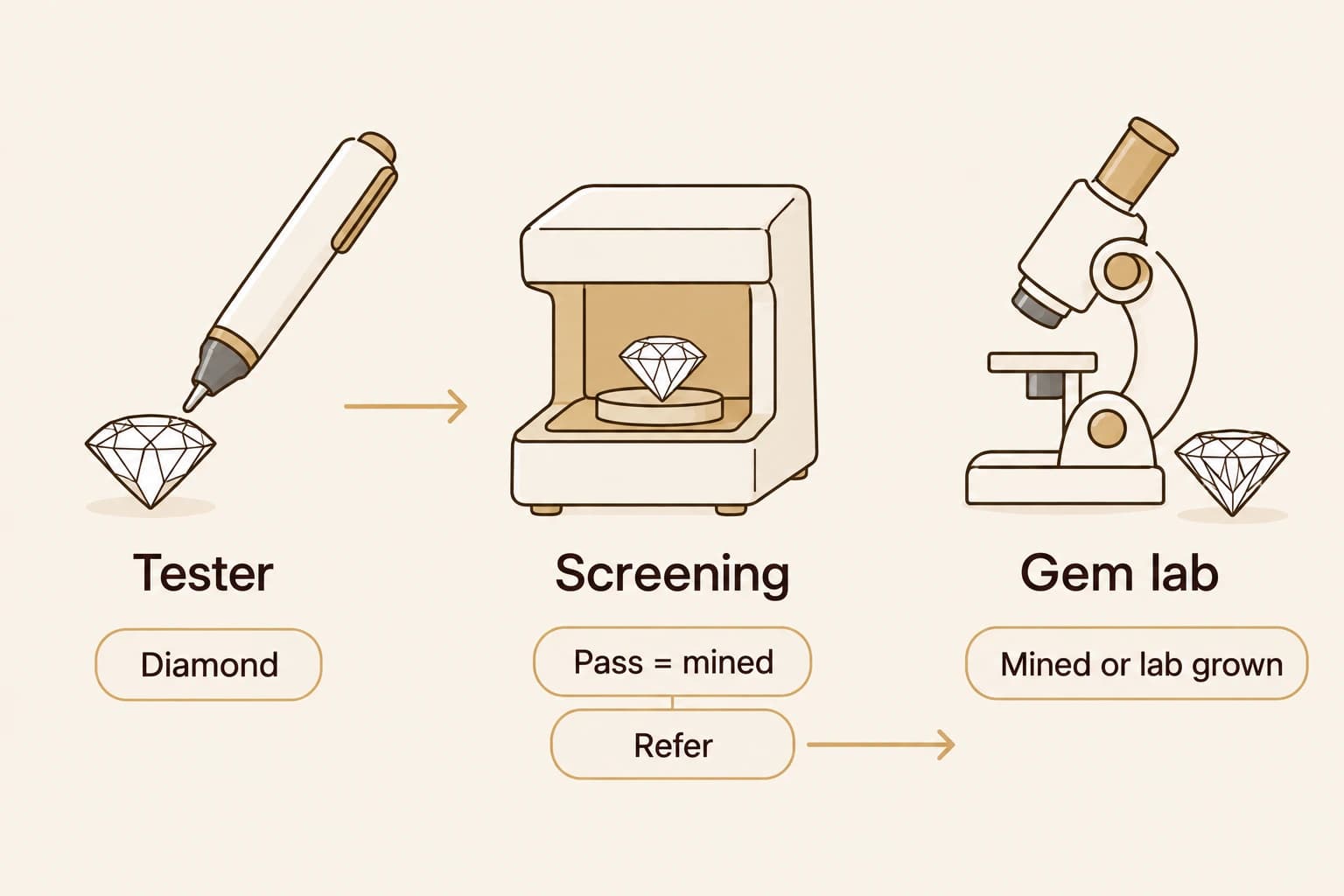
| Screening machine | Partly | "Pass" means mined. "Refer" means only a lab can say. |
| Gem lab | Yes | Spectroscopy and UV imaging read how the crystal grew |
| Report and girdle inscription | Yes, if the stone matches the record | The report states the origin, and the inscription marks the stone itself |
Why every tester says "diamond"
A handheld tester touches a warm tip to the stone and measures how fast the heat drains away. Diamond moves heat far better than glass or cubic zirconia, and a lab grown diamond does it just as well as a mined one. Chemically and optically, the two are essentially the same, so the ordinary tools in a jewelry store, the loupe included, can't separate them.
Testers are made for a different job: catching imitations. Which home checks catch glass, cubic zirconia and moissanite, and which ones prove nothing, is in our guide on how to tell if a diamond is real.
Can a jeweler tell if a diamond is lab grown?
A jeweler with only a tester and a loupe can't. A jeweler with a screening machine can clear most mined diamonds on the spot and set the rest aside for a lab. Only a gem lab, or the stone's own report and inscription, can say for certain that a diamond is lab grown.
Screening machines rely on a detail of the crystal called its type. About 95% of mined diamonds formed with small clusters of nitrogen trapped inside; gemologists call them Type Ia. Only about 1% of mined diamonds have almost no nitrogen, which makes them Type II. Colorless lab grown diamonds are all Type II.
Most screening machines give one of two results. "Pass" means the stone is mined. "Refer" means it could be lab grown, or it could be one of those rare mined Type II diamonds, and it needs further testing to settle it. Some of these machines fit on a store counter and answer in seconds, but not every store has one. If you ask a jeweler whether a stone is lab grown, ask what they'll check it with.
How a gem lab proves where a diamond grew
Lab grown and mined diamonds form in very different conditions, and that leaves tiny differences in the crystal, down to single atoms out of place. A lab combines several methods to find them:
- Infrared spectroscopy measures which light the stone absorbs. It shows the diamond's type: nitrogen or no nitrogen, boron or no boron.
- Photoluminescence spectroscopy shines a laser on the stone and reads the faint light it gives back. A silicon-related signal, for example, points to a diamond grown by CVD (chemical vapor deposition, where carbon from a gas builds up on a seed).
- Deep ultraviolet imaging makes the growth pattern glow. A CVD diamond shows layers, because it grew layer on layer. An HPHT diamond (high pressure, high temperature, grown from molten metal) shows sharp-edged growth zones.
No single signal decides it. The lab reads them together, and the result goes on the report.
Read the inscription, then check the report
The quickest proof of origin is written on the stone. A graded lab grown diamond usually carries a tiny laser inscription on its girdle, the thin edge around its widest part. You can read it with a 10× loupe.
- IGI inscribes every lab grown diamond it grades with "LG" followed by the report number. Our IGI-graded stones are all laser-inscribed.
- GIA inscribes the words "Laboratory-Grown" with its report number.
Then look the number up on the lab's website and check that the shape, weight and measurements match the record. Our step-by-step report check walks through it.
Matching the stone matters because an inscription can be copied. In 2024, a grading lab examined a 6.01 carat pear shape inscribed with the report number of a mined diamond. It was lab grown: photoluminescence showed CVD growth, and the stone didn't match the mined diamond's report. If the number checks out but the stone doesn't, or there's no inscription at all, have a lab test it.
When a lab grown diamond tests as moissanite
Some testers add a second, electrical check to catch moissanite, the most common diamond look-alike, because moissanite and colorless diamond react differently to a small current.
Boron blurs that line. A diamond with boron in it conducts electricity, and boron is common in HPHT-grown diamonds: one lab found it in more than 80% of the colorless and near-colorless HPHT diamonds sent to it since 2020. Not all of them conduct enough to register. In one study of HPHT diamonds, about 1 in 6 did, mostly stones with some color or a faint tint. A tester with an electrical check can read one of those as moissanite.
If that happens to a diamond that came with a report, you haven't necessarily been sold a fake. Read the inscription, check the report, and if you're still unsure, send it to a lab.
If it matters whether your diamond was mined
- Buying new: ask for an IGI or GIA report that states the origin, and check the inscription against it. A tester reading from the seller adds nothing.
- Buying used or inherited, at a mined-diamond price: insist on a lab report. A passing tester proves it's a diamond, and nothing more.
- Selling: say it's lab grown. The inscription and report will tell a careful buyer anyway, and US rules require jewelry businesses to describe a lab grown diamond as lab grown. Resale value is a separate question, covered in are lab grown diamonds worth it.
We sell only lab grown diamonds, so we have no mined stone to talk you into. If you want a mined diamond, the same advice protects you: don't pay a mined price on a tester's word. Get the lab report. If lab grown suits you, every diamond we sell comes with an IGI or GIA report you can look up before you buy. Start with our lab grown diamonds.
Common questions
Yes. A lab grown diamond has the same hardness as a mined one, 10 on the scale used for gems, so it will scratch glass. That makes scratching useless as a test of origin, and it isn't a good test of anything else either: moissanite scratches glass too, and pressing a stone hard against glass can chip its edge.
If they look, yes. A tester gives them the same "diamond" reading either way, but the girdle inscription and the report both say lab grown, and a buyer who has doubts can send the stone to a lab. Assume they'll find out, and tell them up front. It saves time and keeps the sale honest.
Not one by one, as a rule. Side stones this small are hard to handle and too small for some lab instruments, and lab grown ones have turned up mixed into parcels of mined side stones in the trade. Labs now sort them by machine, in batches. A grading report covers a single stone, so if the side stones' origin matters to you, ask the seller to state it in writing.