Do Lab Grown Diamonds Hold Their Value? Where You Could Sell One, and What to Expect
No, and the gap to mined diamonds keeps widening. Where you could still sell a lab grown diamond, what each route tends to give you, and what to do before you buy.
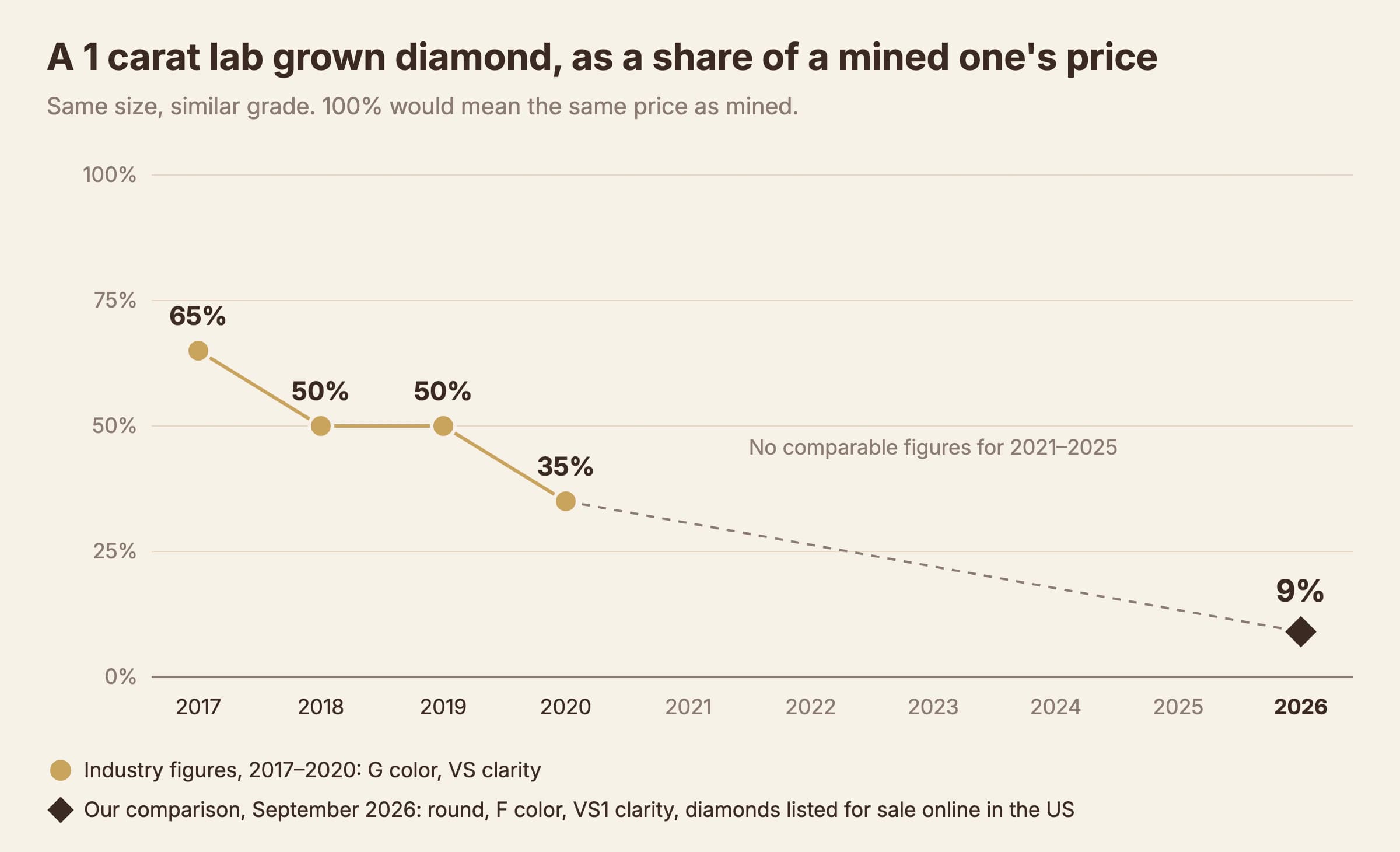
No, lab grown diamonds don't hold their value. In 2017, a 1 carat lab grown diamond cost about two-thirds as much as a similar mined one. In September 2026, among diamonds listed for sale online in the US, it cost about 9%. When new stones keep getting cheaper, a used one can't keep its price.
Worth little isn't worth nothing, though. A lab grown diamond is still a diamond, and some buyers will pay for one. What you get back depends a lot on where you sell it, and the best protection comes before you buy, not after.
Below: how the price gap has moved, where you could sell and what each route tends to give you, how mined diamonds resell, and what to do if you already own one.
What we checked
- When: 28 September 2026, one day's listings
- Stones: 2,818 round diamonds of 1.00–1.09 carats, 2,335 lab grown and 483 mined
- Held the same: F color, VS1 clarity, an IGI or GIA report
- Figure used: the median asking price of each group, meaning the stone halfway down the list from cheapest to most expensive
- Earlier years: 2017–2020 are published industry figures for retail prices at G color, VS clarity. That grade is close to ours, not the same. We found no figures on the same basis for 2021–2025, so the chart leaves those years open
- Limits: asking prices, not what buyers finally paid. We re-check the comparison every three months
You can see today's prices at this size on our 1 carat lab grown diamonds page.
A used lab grown diamond has to compete with new ones
Anyone thinking of buying your lab grown diamond can buy a new one instead, with a fresh report, from many sellers. So the price of a new stone sets the ceiling for a used one, and for lab grown that ceiling keeps coming down. Production has grown fast, mostly in China and India, and the cost of growing each stone has fallen with it. We cover how far retail prices have dropped in are lab grown diamonds worth it?
A buyer of used jewelry also takes a risk. A jeweler who buys from a private seller pays up front for a piece that may sit in the case for a long time, so the offer is usually below the wholesale price, the price the jeweler would pay a supplier for a new stone. Diamond industry analysts say it's already very hard to resell a lab grown diamond, and that as prices keep falling, a real resale market may never form.
Where you could sell a lab grown diamond
You have five routes: the store you bought from, a jeweler or diamond buyer, consignment, selling it yourself, and a pawn shop. None will give back what you paid. Store credit toward a new piece usually comes to more than a cash offer. Selling it yourself cuts out the middleman but takes the most work.
Where you could sell a lab grown diamond
| Route | Takes lab grown? | What to expect | What you'll need |
|---|---|---|---|
| The store you bought it from (trade-in or upgrade) | Only if it has a written policy. We don't offer one | Credit toward another piece, often one that costs more, rather than cash. Credit usually comes to more than a cash offer | The receipt, the report and the piece |
| A jeweler or diamond buyer, for cash | Not always, so ask first | An offer below what the buyer would pay a supplier for a new stone | The report, so they can see what the stone is |
| Consignment with an estate jeweler or a resale site | Not always | You're paid only once it sells, minus a commission, and your price has to beat a new stone's | The report, clear photos and some patience |
| Selling it yourself | Up to you | You keep the whole price, but buyers will compare it with a new stone and may ask for proof | The report and the receipt; meet somewhere safe and public |
| A pawn shop | Not always, so ask first | A quick cash loan or sale, priced so the shop can resell the stone at a profit | The report |
The report does most of the work on every route. It shows the stone is lab grown, states its grades, and lets a buyer price it without sending it to a lab. Buyers lean on it because a lab grown diamond passes the simple diamond testers many stores use; our guide on how to tell if a diamond is real explains why.
We don't offer trade-in, upgrade credit or buyback on lab grown diamonds, so the first row doesn't apply to a stone bought from us. We'd rather you know that now than find out in three years.
Your best chance of getting money back comes before you buy
With us, the only full refund is the return window: 30 days from delivery, with a free US return label and no restocking fee. Send the IGI or GIA report back with the stone. Custom, engraved and resized pieces are final sale. After the window closes, we don't buy stones back.
If resale might matter to you, check these with any seller before you pay:
- The trade-in or upgrade policy, in writing. What share of your price counts as credit, whether you must spend more on the new piece, whether there's a time limit, and whether you need the report and receipt.
- The report. An IGI or GIA report makes any later sale simpler. Every stone we sell comes with one.
- The receipt. Keep it with the report. Together they show what the stone is and what you paid.
Mined diamonds keep more value, but not their retail price
Are lab grown diamonds as valuable as mined ones? No. A mined diamond keeps more of its value than a lab grown one. But it doesn't hold its retail price either. When a mined diamond sells secondhand, it often goes for less than half of what was paid at retail. An appraisal won't tell you what you'd get: an insurance appraisal states the retail replacement value, what a similar new piece would cost, and that's higher than any resale offer.
Mined prices have fallen too. The average price of a 1 carat mined diamond fell by about half between 2021 and September 2026, pushed down by a glut of mined stones and by buyers moving to lab grown. So even the kind of diamond people expect to hold its value has lost ground.
Diamonds are also hard to price secondhand. No two are alike, and there's no open market that quotes a daily price for them the way there is for gold. For that reason we don't suggest buying any diamond, mined or lab grown, as an investment.
If you already own one, it's worth more on your hand
A lab grown diamond doesn't wear out. It has the same hardness as a mined diamond, 10 on the scale used for gems, so with a little care it will look the same in decades. That leaves better choices than a small cash offer:
- Reset it. A new setting changes the whole look of a ring, and the stone doesn't need replacing. We take on rework through our custom ring request, and our engagement rings show the settings we make.
- Pass it on. It will look the same for the next person who wears it.
- Keep the insurance in line. An insurance appraisal states replacement value, and your premium is based on it. If lab grown prices keep falling, an older appraisal can say the ring costs more to replace than it now does. A jewelry insurer we checked recommends a new appraisal every two years. Make sure it says the stone is lab grown.
Who should care about resale, and who shouldn't
If you expect to sell the stone in a few years, or you want it to hold value, a lab grown diamond is the wrong choice. A mined one keeps more, though still well short of its retail price. We set out who should buy mined in are lab grown diamonds worth it?
If you're buying a diamond to wear, the value that counts is what you get on the day: a bigger or better stone for a small fraction of the mined price, and that gap grows at larger sizes. We sell only lab grown diamonds, and we don't buy them back, so weigh both when you choose. You can compare sizes and grades side by side in our lab grown diamonds.
More questions about resale
Nobody can promise either way, and we won't make a forecast. The trend so far has been down, and steeply, as the chart above shows. Mined prices move too, so the gap can change from both sides. We re-check the comparison every three months and update the chart when it moves.
You can usually recover the details. IGI and GIA both laser-inscribe the report number on the edge of the lab grown diamonds they grade, so a jeweler with a loupe can read it, and both labs let you look up a report online by its number. Without a report or an inscription, a buyer may want the stone checked by a lab first.