How Lab Grown Diamonds Are Made, and What the Method Changes for You
Lab grown diamonds are grown by CVD or HPHT. Which method is behind most stones for sale, what each one leaves in the diamond, and how to read it on the report.
Lab grown diamonds are made in one of two ways. HPHT copies the crushing heat and pressure deep in the earth: carbon dissolves in molten metal and crystallizes on a tiny diamond seed. CVD builds a diamond from carbon-rich gas, one thin layer at a time. Both make diamond, the same carbon crystal as a mined one.
What's less known is that each method leaves its own marks in the stone, and the grading report says which one made yours. We also counted which method grew the lab grown diamonds listed for sale online in the US. About two in three rounds were CVD, and from 2 carats up it was about four in five.
Below: the two methods in plain words, what each changes about the stone you buy, how to read it on the report, and how a 1950s lab experiment ended up in engagement rings.
Two ways to grow a diamond
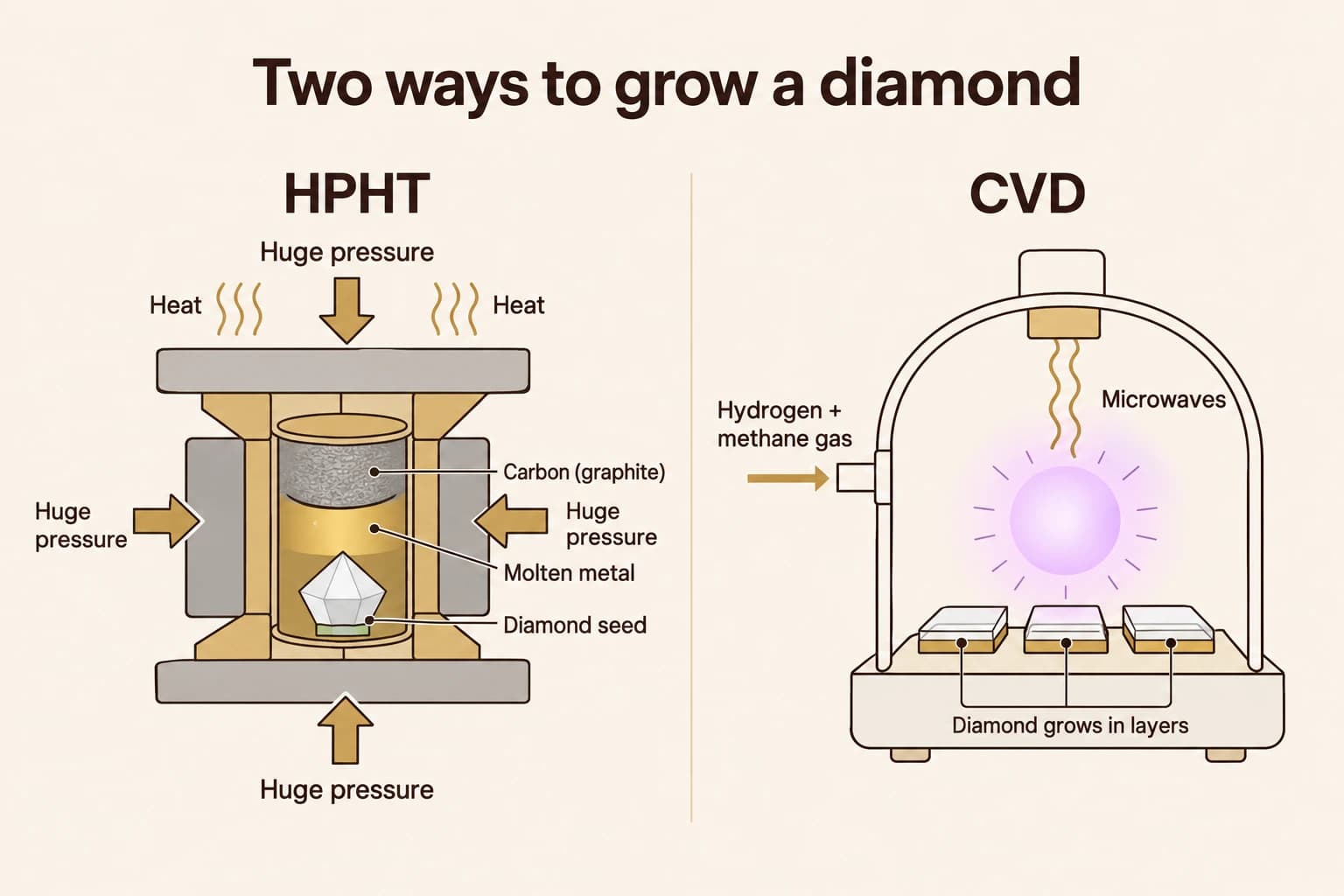
HPHT stands for high pressure, high temperature. A small diamond seed goes into a press with a carbon source, such as graphite, and a metal, usually iron, nickel or cobalt, that melts and dissolves the carbon. The press squeezes it at about 50,000 to 60,000 times the air pressure at sea level, the pressure you'd find 90 to 120 miles underground, and heats it to about 2,400 to 2,900 °F. The carbon moves through the molten metal and builds up on the seed as a new crystal.
CVD stands for chemical vapor deposition. Thin, flat diamond seed plates sit in a sealed chamber. A gas mix goes in, mostly hydrogen with a little methane, and microwaves turn it into a glowing ball of plasma. Carbon from the methane settles on the seeds and builds up layer by layer. The chamber runs at about 1,650 to 2,200 °F, but at lower pressure than the air around us.
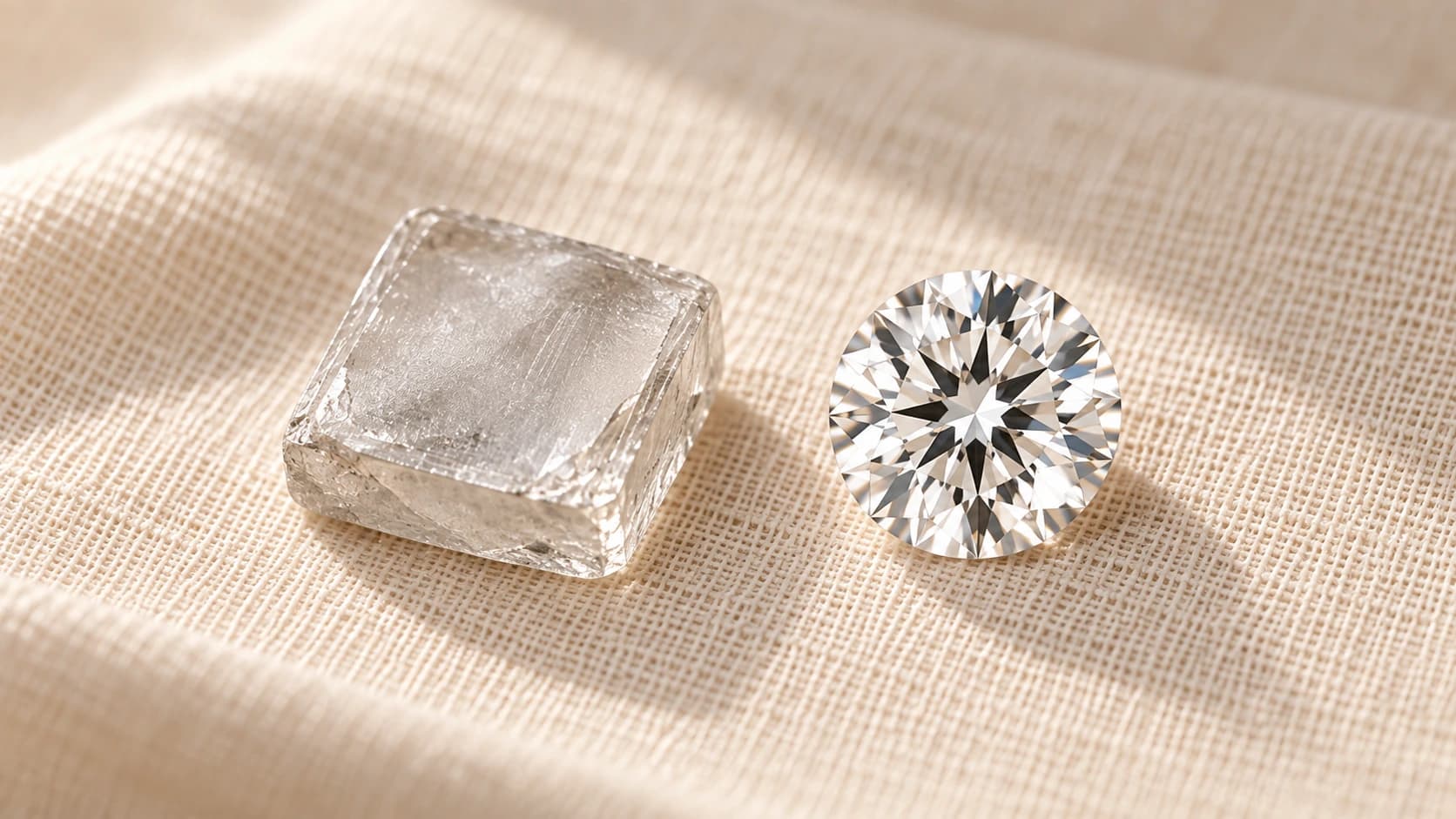
Either way, what comes out is carbon crystallized in the same structure as a mined diamond, with the same hardness of 10. A lab grown diamond is a diamond. Straight out of the machine, the two look different: an HPHT crystal has a chunky shape with both square and triangular faces, while a CVD crystal is a flat, square plate. Both are then cut and polished like any rough diamond.
The bigger the stone, the more likely it's CVD
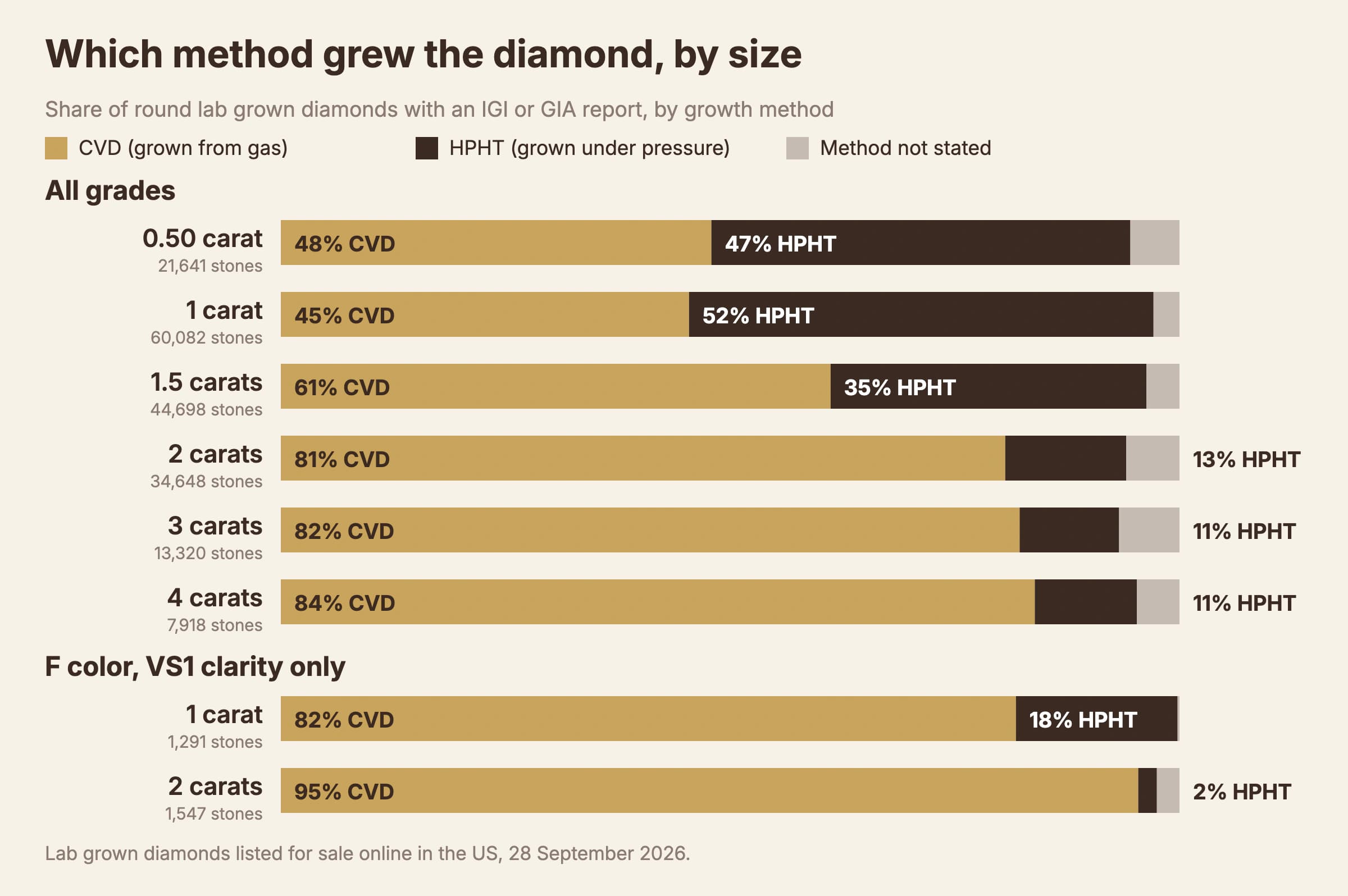
We counted the growth method on 396,197 round lab grown diamonds with an IGI or GIA report, listed for sale online in the US. 65% were grown by CVD and 30% by HPHT; the rest didn't say.
Size changes the picture. Up to about 1 carat, the two methods are close to even, and HPHT is slightly ahead at 1 carat. From 2 carats up, about four in five stones are CVD. The grade shifts it too. At F color and VS1 clarity, a popular choice, 82% of 1 carat stones and 95% of 2 carat stones were CVD.
What we checked
- When: 28 September 2026, one day's listings
- Stones: 396,197 round lab grown diamonds with an IGI or GIA report, listed for sale online in the US; 182,307 of them in the six size bands in the chart
- Sizes: narrow bands of 0.50–0.59, 1.00–1.09, 1.50–1.59, 2.00–2.09, 3.00–3.09 and 4.00–4.09 carats, all grades; then F color, VS1 clarity at 1 and 2 carats (1,291 and 1,547 stones)
- Figure used: the share of stones in each band listed as CVD, HPHT or no method stated
- Limits: one large listing feed on one day. The method is what the seller lists from the grading report. Up to 7% of stones in a band had no method stated
The split lines up with where lab grown diamonds are made. In 2020, China grew the most, mostly with HPHT presses, and it mass-produces the tiny stones used as accents. India came second, mostly with CVD, and the US third, all CVD. So if you're shopping at 2 carats or more, such as our 2 carat lab grown diamonds, expect most of what you see to be CVD. That's not a warning. It's where the supply is.
CVD vs HPHT: what the method means for the stone you buy
| CVD | HPHT | |
|---|---|---|
| How it grows | Carbon from a gas settles on flat seed plates, layer by layer | Carbon dissolves in molten metal and crystallizes on a seed |
| Conditions | Very hot, below normal air pressure | Very hot, crushing pressure |
| Time to grow | About three or four weeks per batch | An hour to a few weeks, depending on size |
| Typical inclusions | Dark specks of graphite, no shine | Dark bits of metal that shine in reflected light |
| Color improved after growth? | Common in colorless stones | Less common |
| Glows after a UV lamp is switched off? | Rarely, and weakly | Often, in colorless stones |
| Share of listings at 2 carats | 81% | 13% |
| What the report says | The method and a treatment note | The method and a treatment note |
| Is it a diamond? | Yes | Yes |
What the method leaves behind
The method doesn't decide how good a stone is. The grade does. But each method leaves fingerprints, and a few of them are worth knowing when you choose.
Inclusions. Both kinds can have inclusions, and both are graded on the same clarity scale as mined diamonds. The type differs. An HPHT stone can hold bits of the metal it grew in, which look black but shine like metal when light hits them. A CVD stone can hold dark specks of graphite, with no shine. At VS clarity or better, you'll almost never see either without magnification.
Color treatment. This is the one most buyers never hear about. Many CVD crystals come out of the chamber brownish. To fix that, makers heat them again, often in an HPHT press, which takes the brown out. Of the CVD diamonds sent to one major grading lab since 2020, about 80% had been treated this way. Brown is less common in HPHT crystals, so they're treated less often. A treated stone's color grade describes the color you see, so treatment isn't a reason to avoid a stone. Some buyers still prefer an untreated one, and that's a fair choice. You'll just have fewer to pick from at 2 carats and up.
Afterglow. Put a colorless HPHT diamond under a lab's short-wave UV lamp, switch the lamp off, and it often keeps glowing for a while, usually blue-green. Traces of boron cause it. Untreated CVD stones almost never do this. You won't see it in daylight. It's a clue for a lab, not a flaw.
Magnets. An HPHT stone with large metal inclusions can sometimes be picked up by a strong magnet. CVD stones have no metal in them to pull. It's a quirk, not a test: a stone that doesn't react proves nothing.
So buy the grade and the report, not the method. A step in color or clarity moves the price far more than the growth method does. Our lab grown diamonds include both kinds, side by side.
Where the method shows on your report
An IGI report on a lab grown diamond states the growth method in its Comments. The same note says whether the lab found signs that the color was changed after growth. You'll see one of three wordings:
- "As Grown – No indication of post-growth treatment." The lab found no sign of treatment.
- "…and may include post-growth treatment." The lab couldn't confirm either way. You'll see it on CVD reports.
- "Indications of post-growth treatment." The lab found signs the color was treated.
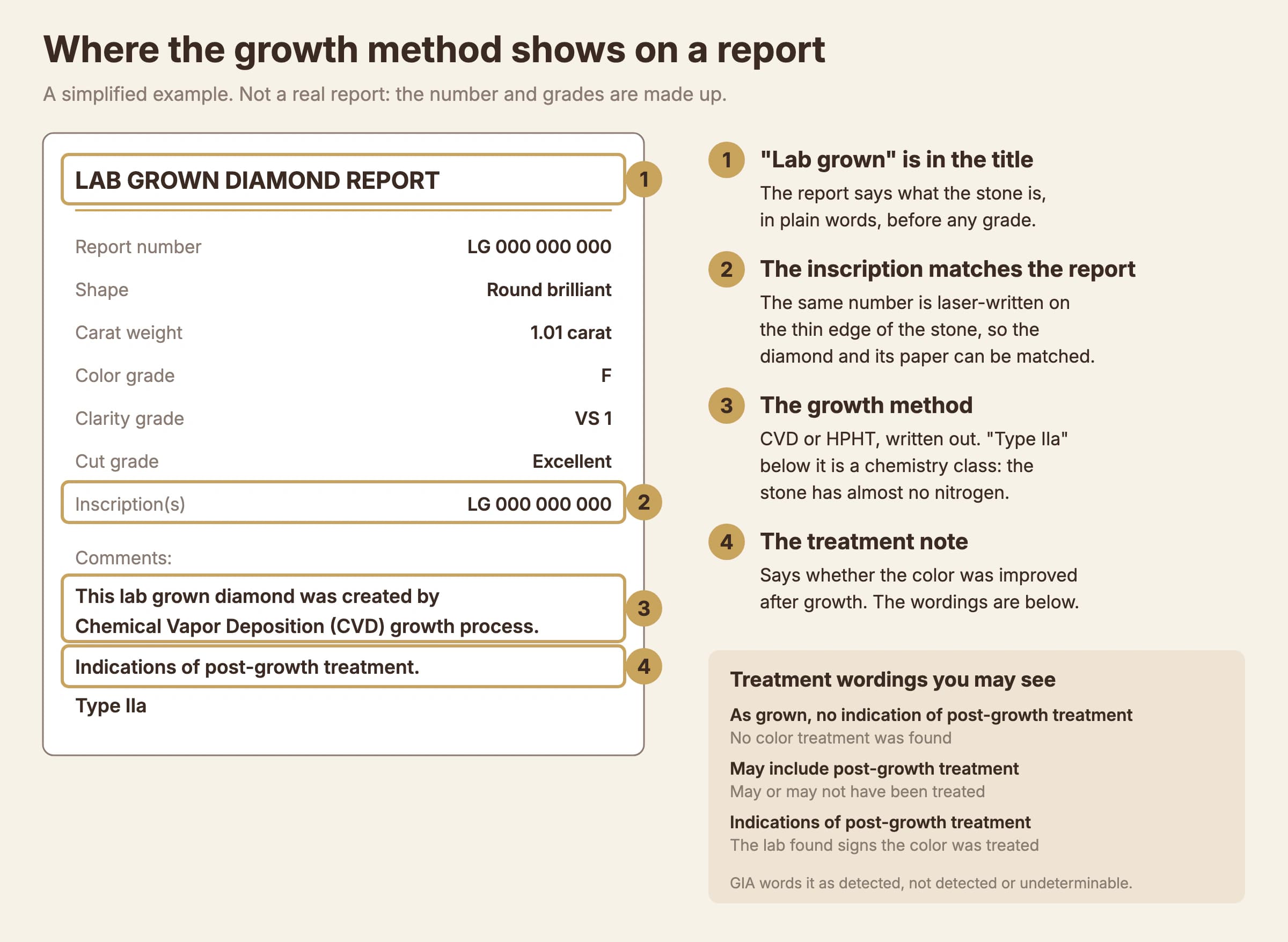
The report number is also laser-inscribed on the stone's thin edge, with "LG" in front of it on IGI stones, so the diamond and its paper can be matched. Every IGI stone we sell carries that inscription.
GIA reports on lab grown diamonds issued before October 2025 also state the growth method, and say whether treatment was detected, not detected or couldn't be determined. GIA changed how it describes lab grown diamonds in October 2025, which we cover in are lab grown diamonds worth it? If the method isn't printed on the document for a stone you like, ask us before you buy.
Seventy years from lab experiment to engagement ring
- 1952. Diamond is first grown from a gas, the start of CVD. For decades the crystals are far too small and poor for jewelry.
- December 1954. H. Tracy Hall, part of a General Electric team in Schenectady, New York, grows diamond from carbon under high pressure and heat, in a way that can be repeated. GE announces it in February 1955. The first stones are tiny and meant for industry.
- 1970 to 1971. GE grows the first gem-quality lab diamonds by HPHT. Once cut, they weigh about a quarter of a carat each.
- Mid-1980s. Gem-quality lab grown diamonds are first sold, in 1984, and makers start growing gem crystals in commercial quantities.
- Early 2000s. Gem-quality CVD stones appear, in small numbers and mostly under half a carat.
- Mid-2010s. Colorless lab grown diamonds reach the jewelry market in commercial quantities. Around 2016, CVD stones start to outnumber HPHT ones sent for grading.
Since then, production has grown fast and prices have fallen. We look at what that means for value in are lab grown diamonds worth it?
Choosing between a CVD and an HPHT stone
For most buyers, the honest answer is not to choose by method at all.
- Judge the stone, not the process. Color, clarity and cut decide how a diamond looks. Watch the 360° video, which most of our diamonds have.
- Read the Comments line. If an untreated stone matters to you, look for "As Grown", and ask us to check the report before you order.
- Match the inscription to the report when your diamond arrives. We explain how in how to tell if a diamond is real.
We sell both CVD and HPHT diamonds, each with an IGI or GIA report, so we gain nothing by steering you to one. We sell lab grown diamonds only, though. If you want a mined diamond, you'll need another store.
More questions about how they're made
Yes. Blue lab grown diamonds are typically grown with a little boron added, the same element that makes most mined blue diamonds blue. Pink ones are mostly CVD stones that get their color from treatment after growth, such as irradiation and heating. Whatever the color, the report says the stone is lab grown and whether its color was treated.
No. The heat treatment that takes the brown out of CVD diamonds changes how the atoms sit inside the crystal, so it's considered permanent. Undoing it would take another treatment at least as strong as the first. The treatments used to create pink and other fancy colors are considered permanent too.