Lab Grown Diamond or Moissanite? The Differences You Can Measure
Moissanite isn't a kind of lab grown diamond. Here's how the two compare on fire, hardness, weight, testers and reports, and who should choose which.
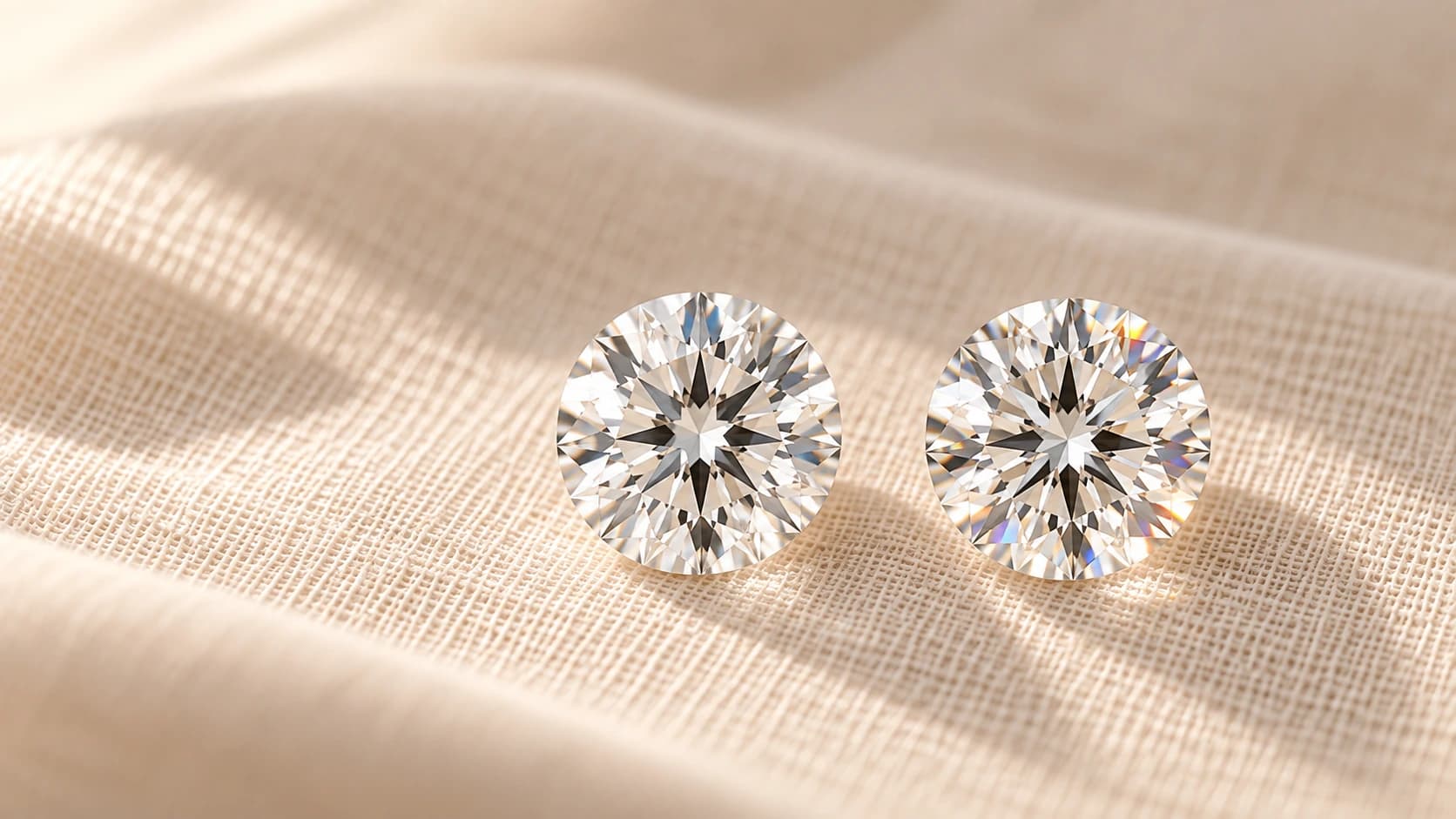
Lab grown diamonds vs moissanite isn't a choice between two kinds of diamond. A lab grown diamond is a diamond: pure carbon, in the same crystal as a mined one. Moissanite is silicon carbide, a different crystal that splits light into more than twice as much colored fire. We sell lab grown diamonds and don't sell moissanite, so we have a side. That's why the table below sticks to what a gem lab can measure.
After the table: what you'll see on the hand, how each one wears, why the same size doesn't weigh the same, what a tester and a lab report will say, and who should choose which.
Lab grown diamond vs moissanite, measured
| Lab grown diamond | Moissanite | |
|---|---|---|
| What it is | Carbon in a cubic crystal: a diamond, grown in a lab | Silicon carbide: a different gem, made in a lab |
| Hardness (Mohs scale, 10 is the top) | 10 | 9.25 |
| Toughness (how well it resists chipping) | Good to excellent. A hard blow can split it along its cleavage | Excellent. No cleavage |
| Refractive index (how strongly it bends light) | 2.42 | 2.65 to 2.69 |
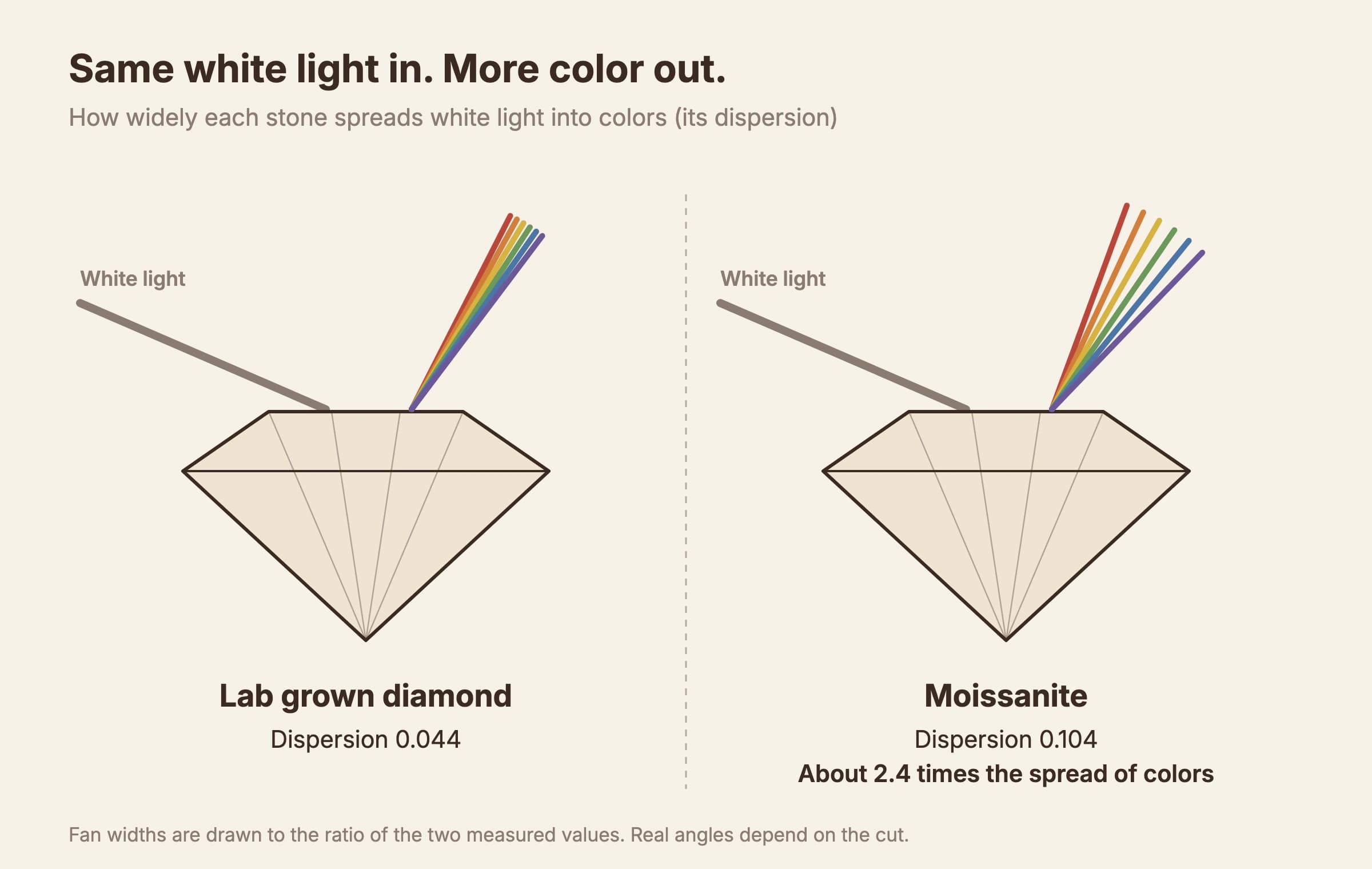
| Dispersion (how much it splits light into colors) | 0.044 | 0.104, about 2.4 times as much |
| Double refraction | None | 0.043. Back facets look doubled when you look in at an angle |
| Specific gravity (density) | 3.52 | 3.22, so about 9% lighter at the same size |
| Color | Rated on the IGI or GIA report | Colorless to near colorless. Some look slightly yellow, gray or green at certain angles |
| Basic diamond tester | Diamond | Diamond |
| Tester with a moissanite check | Usually diamond | Moissanite |
| Lab paperwork | IGI or GIA grading report | An identification report at most. It isn't graded like a diamond |
| What US rules let you call it | Diamond, with "lab grown" or similar right beside the word | Moissanite. Never a diamond |
Moissanite shows more color. A diamond shows crisper facets.
Dispersion is how much a gem splits white light into its colors, the way a prism does. At 0.104, moissanite's is about 2.4 times a diamond's 0.044, so it throws far more flashes of rainbow color. The amount of white light each one returns is close. It's the color that differs.
The effect grows with size. In stones of about a carat and up, gemologists note that moissanite's strong fire can give it away as something other than a diamond, a look sometimes called the "disco ball" effect. Whether that's a plus is a matter of taste. Some people choose moissanite for exactly that colorful sparkle. Others find it too busy and prefer a diamond's mix of white light and color.
The second difference is inside the stone. Moissanite is doubly refractive: light entering it splits into two rays. Look into it at an angle through a loupe and the back facet edges show twice, and the inside can look a little blurry. A diamond doesn't split light this way, so its facet edges stay sharp. Our guide on how to tell if a diamond is real shows what to look for.
Color is the last thing you'll notice. Moissanite runs from colorless to near colorless, and some stones show a faint yellow, gray or green tint at certain angles. How colorless a moissanite looks does much of the work in setting its value.
Both are hard enough for every day
A diamond is 10 on the Mohs scale, the top. Moissanite is 9.25, harder than sapphire and ruby at 9. What matters day to day is dust and sand, which are mostly quartz, a 7. Both stones sit well above that, so neither will scratch from ordinary wear.
The scale hides how big the top steps are. Measured by how hard it is to dent the surface, the step from sapphire up to moissanite is bigger than the step from topaz (8) up to sapphire, and diamond is far harder again.
Hardness isn't the whole story, though. Toughness, how well a stone resists chipping and breaking, favors moissanite. Gemologists rate its toughness as excellent, and it has no cleavage, the flat planes along which a diamond can split. A diamond's toughness is good to excellent, but a hard knock on an edge or a point can still chip it. So for durability, moissanite is a strong everyday stone. We cover how to protect a diamond from chips in are lab grown diamonds worth it.
The same size doesn't weigh the same
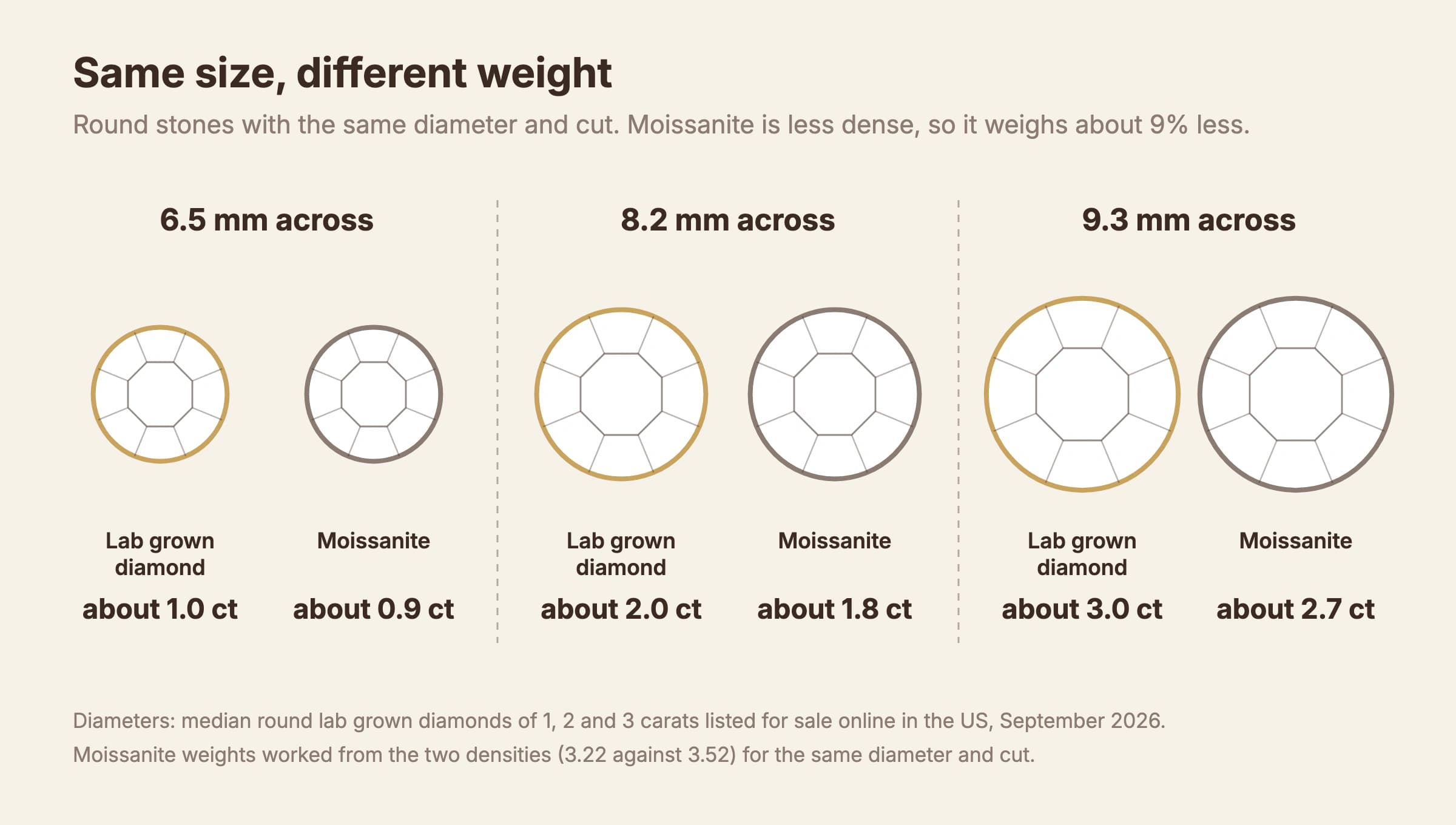
Moissanite is less dense than diamond, 3.22 against 3.52, so a moissanite cut to the same size and shape weighs about 9% less. A 6.5 mm round diamond weighs about 1 carat. A moissanite with the same diameter and cut weighs about 0.91 carat.
That 6.5 mm is also what a typical 1 carat round lab grown diamond measures. Across more than 100,000 round lab grown diamonds of 1 to 1.09 carats listed for sale online in the US, the median diameter was 6.51 mm. The chart below carries the same comparison up to 2 and 3 carats.
What we checked
- When: 28 September 2026, one day's listings
- Stones: round lab grown diamonds, D to H color, FL to VS2 clarity, with a GIA or IGI report: 102,839 at 1.00 to 1.09 carats, 40,939 at 2.00 to 2.09 and 12,076 at 3.00 to 3.09
- Figure used: the median diameter, the stone halfway down the list from smallest to largest
- Moissanite weights: the diamond weight multiplied by 3.22 ÷ 3.52, for the same diameter and cut
- Limits: actual stones vary in depth and cut, so a single stone can weigh a little more or less than these figures
So compare the two by millimeters, not carats. Carat is a weight, and these stones don't weigh the same for their size. If a moissanite is described in carats, ask whether that's its own weight or the diamond size it's meant to match. When you browse our 1 carat lab grown diamonds, check each stone's measurements, not just its weight.
What a tester, a loupe and a lab will say
A basic diamond tester measures how fast a stone draws heat away, and moissanite handles heat so much like diamond that the tester reads "diamond" for both. Testers with a second check made for moissanite are built to flag it. A loupe works too, if you know what to look for: the doubled facet edges described above. A gem lab separates the two easily; the difference in density alone gives moissanite away.
Paperwork is the bigger difference. Every lab grown diamond we sell comes with an IGI or GIA grading report, and the report states that the diamond is lab grown. Moissanite isn't graded on the diamond scales. GIA, for one, issues grading reports only for diamonds; other gems get an identification report, which says what the stone is but gives no diamond grades.
Only one of them may be called a diamond
US jewelry rules define a diamond by what it is: carbon crystallized in the cubic system, with a hardness of 10. A lab grown diamond meets that definition, so it's a diamond, as long as the seller puts "lab grown" or a similar phrase right beside the word. Moissanite doesn't meet it. Calling moissanite a diamond, or a lab grown diamond, is deceptive under the same rules. It can be sold as moissanite, lab-created moissanite or a simulated diamond.
Neither one may be called "real", "genuine" or "natural", because both are made in a lab. Moissanite does occur in nature, but only as tiny grains. It's named after Henri Moissan, the chemist who found natural silicon carbide in a meteorite. So the moissanite in jewelry is made in a lab, and colorless moissanite has been sold as a gem since the late 1990s.
Which one fits you
| If you want | Choose |
|---|---|
| The word "diamond" on the ring, and a grading report | Lab grown diamond |
| The most colored fire | Moissanite |
| Crisp facet edges, even under a loupe | Lab grown diamond |
| To compare stones by carat, color and clarity grades | Lab grown diamond |
| A hard stone for everyday wear | Either. Both are far harder than dust, and moissanite is the tougher of the two |
| Something to sell later | Neither. Both are made in labs in growing numbers, and prices for both have fallen in recent years |
We haven't put prices here, because they move too often for both stones. If price decides it, compare the two at the same size in millimeters, not the same carat weight.
If moissanite's fire is what you love, it's a fair choice, and a store that specializes in it is the place to buy one. If you want a diamond, start with our lab grown diamonds or our lab grown diamond engagement rings.
Common questions
No, the stone itself doesn't change. Silicon carbide is very stable: it resists most chemicals and holds up in air at temperatures far beyond anything a ring will meet. When a moissanite looks dull, the cause sits on the surface, usually a film of skin oil, lotion or soap. The same film dulls a diamond, and cleaning removes it.
Not when it's sold as moissanite. It's a gem of its own, silicon carbide made in a lab, with more fire than a diamond and slightly less hardness. It only becomes a fake when someone passes it off as a diamond. If a stone sold as a diamond comes without a lab report, ask for one before you buy.