Engagement Ring vs Wedding Ring: What's the Difference?
One is built to lift a stone into the light, the other to lie low and flat. How the two rings differ, how to make them sit flush, and how to stop them wearing each other.

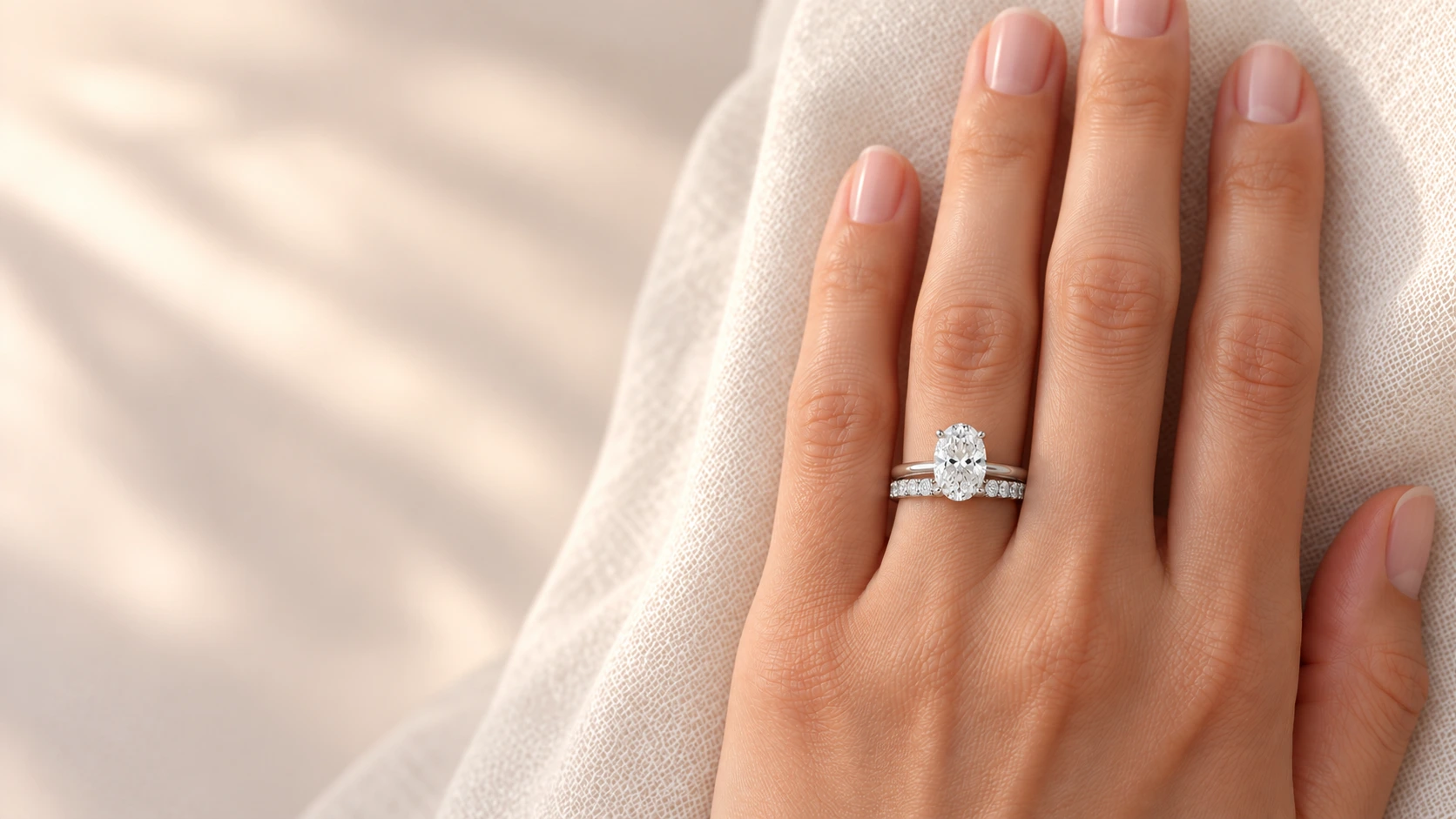
The difference between an engagement ring and a wedding ring starts with timing: one is given at the proposal, the other at the wedding. But if you plan to wear both, the difference that matters day to day is shape. An engagement ring is built to lift a stone into the light. A wedding band is built to lie low and flat. Put them on the same finger and those two designs have to get along.
The timing part is quick. Most of this guide is about the fit: how to choose a band that sits against your engagement ring without a gap, and how to keep the two from wearing each other down.
Engagement ring | Wedding band | |
|---|---|---|
When it's given | At the proposal | At the wedding ceremony |
Who wears it | In the US, traditionally the person proposed to | Usually both partners |
How it's built | A center stone raised in a head, held by prongs or a bezel | A low band, plain or set with small diamonds |
What it stands for | The promise to marry | The marriage itself |
After the wedding | By custom, worn on top of the band | Worn closest to the hand |

Why the two rings are built so differently
An engagement ring has one job: show off the center stone. So the stone sits up in a head, held by prongs or wrapped in a bezel, with an open gallery underneath to let light in. The shoulders slope down from the head to the shank, the part that goes around your finger. The higher the head, the more the stone catches light, and the more it can knock against things.
A wedding band is built the other way: low, smooth and even all the way around. Nothing sticks up, so it's comfortable to wear every day and hard to snag. That's also why many people take the engagement ring off for the gym, gardening or cooking, and keep the band on.
These two shapes are fine on their own. The trouble starts when they meet on one finger.
Will a straight band sit flush against your engagement ring?
A band sits flush when nothing on the engagement ring is in its way. Look at your ring from the side. If there's clear space under the head, a straight band can slide underneath and sit tight against the shank. If the head, a halo, or the shoulders come down to the finger, a straight band will stop short and leave a gap.
| Engagement ring | With a straight band | What usually works |
|---|---|---|
| Solitaire with a high head | Slides under the stone and sits flush | A straight band |
| Solitaire with a low head | The head blocks it and leaves a gap | A curved or notched band |
| Cathedral (arches lift the head) | Often flush, unless the arches start low on the shank | A straight band; check the side view |
| Halo or hidden halo set low | The halo sits in the band's path | A curved (contour) band, or accept a small gap |
| Bezel set low | The metal rim reaches the band line | A curved or notched band |
| Split, twisted or curved shank | The band can't follow the shape | A contour band made to match that ring |
A curved or contour band has a gentle dip in the middle that hugs the head. A notched band has a small cut-out instead. Both close the gap, but they only fit the ring they were shaped for, so choose the engagement ring first and the band second.
A small gap isn't a flaw. Some people like the look of two separate rings. It only matters if the gap bothers you.

How to match a wedding band to your engagement ring
Once the side view tells you whether you need a straight or a curved band, three choices are left.
The shape of the band. A curved band, also sold as a contour band, is made to nest around the center stone so there's no gap under it. A notched band does the same with a small cut-out. Some stone shapes have a usual partner:
| Engagement ring | Band people often choose |
|---|---|
| Pear | A V-shaped (chevron) band, with the pear's tip pointing down into the V |
| Marquise | A V-shaped band that echoes the stone's two points |
| Oval or round | A contour band, or a thin straight band if the head sits high |
The width. Matching widths is the traditional choice, but pairing a slim band with a wider one is common now. Worn together, the two rings act like one wide ring, and wide rings fit tighter, often needing a half to a full size larger than narrow ones. If the pair is wider than about 4 to 5 mm, get sized while wearing both.
The inside of the band. A comfort-fit band is curved on the inside, so it slides over the knuckle more easily. A traditional band is flat inside. The two can feel different at the same size, so try the band on, or ask for it to be sized for that fit.
Rings that touch need a little care
Two rings on one finger touch every time you move your hand, and that adds to normal wear in two ways:
- Prongs work loose. Prongs bend and loosen over time on their own, especially on a high-set ring that catches on things, and a band knocking against them doesn't help. A quick check once a year catches it early: hold the ring by the band and tap it gently. A loose stone rattles.
- Stones meet stones. Diamond is the hardest natural material, so one diamond can scratch or chip another. A diamond band grinding against a diamond engagement ring is the pairing to watch.
A slim plain spacer band between two diamond rings keeps them apart, or you can move one ring to another finger for rough jobs. Metal choice changes upkeep too. White gold gets its bright white color from rhodium plating, which, as GIA notes, wears away over time and needs redoing now and then. Platinum is naturally white, so there's no plating to redo. You can compare metals and styles in our lab grown diamond engagement rings and lab grown diamond wedding rings; an eternity band is the classic stacking choice because it looks the same from every angle.
One ring, two rings, or a set
Two rings on one finger is the US custom, not a rule. Couples also wear a band only; wear the engagement ring alone as their wedding ring, which works best with a solitaire or bezel that already looks complete; or buy a set designed to sit together from the start.
Who wears what changes with the country too. In the US, it's traditionally only the person being proposed to who gets an engagement ring. In Sweden and Norway, both partners often wear a simple engagement band. Even the man's wedding band is fairly new: GIA dates it to World War II, when it became common for men to wear one. We cover which hand the rings go on, and where that changes, in which hand a wedding ring goes on.
Why the engagement ring is usually a diamond
It hasn't always been. The diamond only became the expected choice in the US after De Beers launched the slogan "a diamond is forever" in 1947. The share of US brides who received a diamond engagement ring rose from 10% in 1939 to 80% by 1990.
We sell diamond rings, so that's an awkward bit of history for us to point out. It's also freeing. Most of the "rules" about these two rings are habit and advertising, which means the only rules that really matter are the practical ones above: the band has to fit, and the rings shouldn't wear each other out.
Common questions
Yes. Plenty of couples use one ring for both, especially when it's a solitaire or a bezel setting that already looks complete on its own. Some add a band years later for an anniversary instead. There's no rule that the wedding ring has to be a separate band, so choose what you'll actually enjoy wearing every day.
No. Many couples buy the band months later. The one thing to plan early is fit: if your engagement ring sits low, the band may need a curved or notched shape made for it. Choosing the engagement ring first, and checking it from the side, tells you which kind of band to look for.
By American tradition, each partner buys the other's wedding band, so neither pays for their own. Today there's no fixed rule. Many couples pay for both bands from shared money, some each buy their own, and some split the cost. Most shop for the bands together, so both get sized on the same day.
As many as you like. A common stack is the engagement ring with a band on each side, sometimes called guard bands, and some people add an anniversary band later. The practical limits are comfort and wear: three or more rings on one finger can feel wide, and every extra diamond band is another surface rubbing on the others.
No. There's no rule that they share a metal, a style or the same number of stones. The band only needs to sit well beside the engagement ring and look right to you. One practical point: if you pair platinum with gold, the softer gold can wear down faster where the two rings rub, so have both checked now and then.
Yes. Both names mean the ring you exchange at the wedding. "Band" is often used for a simple, even ring with no raised center stone, which is what most wedding rings are.
A ring is a circle with no beginning and no end, so it has long stood for a love meant to last forever. That idea may go back as far as ancient Egypt. The Romans used rings in marriage too, first iron and copper, and later mostly gold.
Yes, and many people do. An eternity band sits low and even, so it usually lies flush against an engagement ring. The catch is sizing. A full eternity band has stones all the way around, which makes it very hard to resize later. A half eternity band leaves plain metal at the back, which gives a jeweler room to work, so get sized carefully before you order.
Start looking about six months before the wedding. Ordering and sizing often take six to eight weeks, and custom or engraved bands can take longer. Starting early also leaves time for a resize if the first fit is off.