Which Hand Does a Wedding Ring Go On?
In the US, it's the left hand, fourth finger. Here's where the "vein of love" story comes from, which ring goes on first, and where the right hand is the custom.

What hand does a wedding ring go on? In the US, the left. It goes on the fourth finger, the one next to your pinky, and that's the same for men and women.
Travel a little and the answer changes. In Germany, Poland or Russia, you'll see plenty of wedding rings on the right hand. Neither side is "correct." It's custom, and custom depends on where you live and how your family marries.
Below: why the left hand won out here, which ring goes on first when you have two, and what to check before you order a band.

The "vein of love" story isn't true
You've probably heard that a vein runs from the left ring finger straight to the heart. Its old Latin name is vena amoris, the vein of love. It's a nice story, but anatomy doesn't back it up. Every finger has veins that lead back to the heart, and none has a special line of its own.
The idea is very old. GIA traces it back to the ancient Egyptians, who believed this finger held a vein that ran straight to the heart.
So why the left hand? Mostly habit, handed down. There's a practical upside, too: most people are right-handed, so a ring on the left hand takes fewer knocks.
Band first, then the engagement ring
If you wear both rings on one finger, the usual order is the wedding band first, closest to your hand, with the engagement ring on top. The explanation you'll usually hear is that the band, the vow itself, should sit nearest the heart.
That's why some brides move their engagement ring to the right hand for the wedding day. The left ring finger is bare for the ceremony, the band goes on, and the engagement ring goes back on top afterward.
Plenty of people wear them the other way round because they like the look. When your rings arrive, try both orders for a day or two. The one that feels right on your hand is the right one.
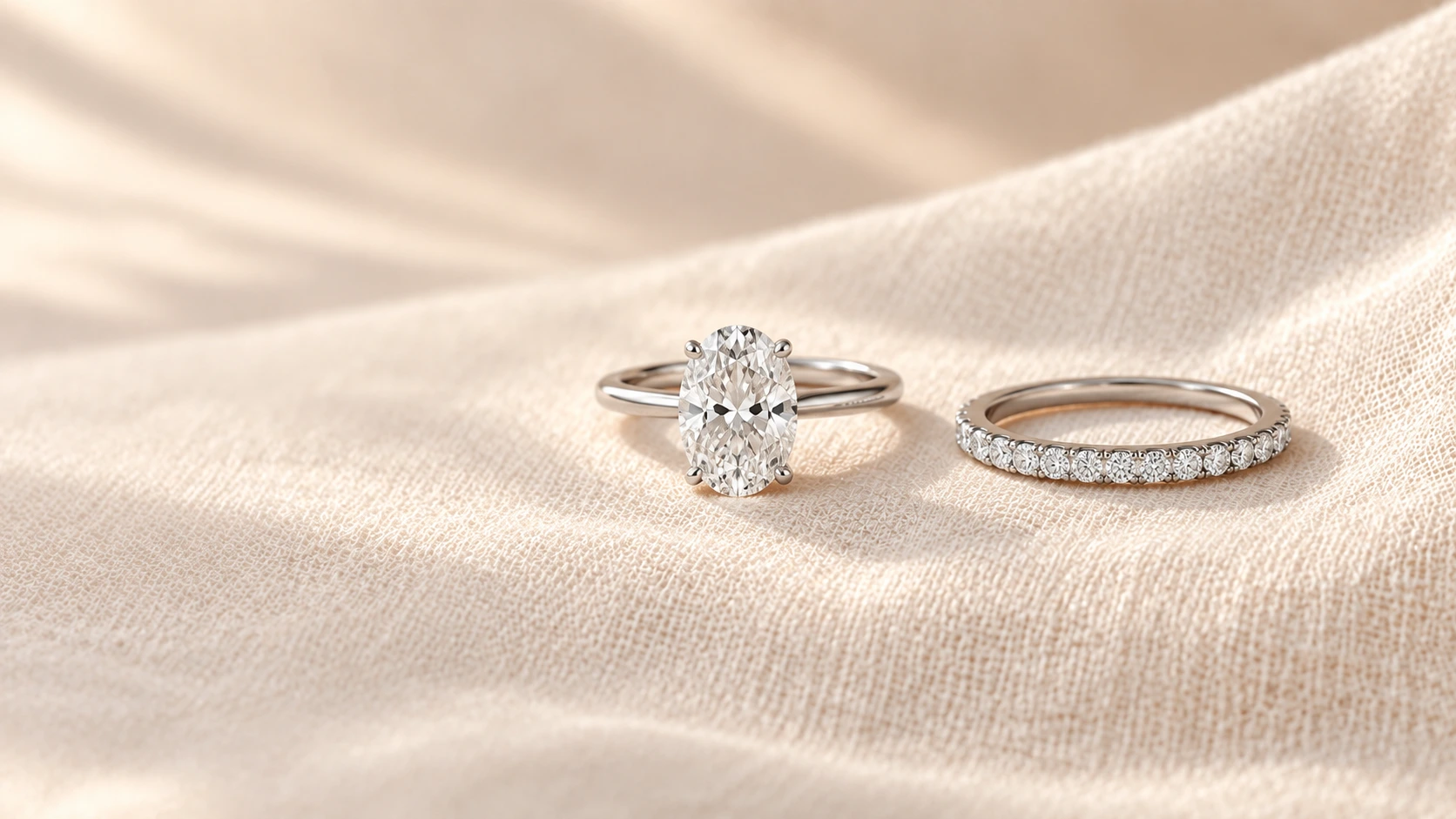
What does matter is fit. The two rings should sit flush, with no gap and no grinding. A low setting, or a halo that sits down on the finger, often needs a curved or notched band to tuck in beside it. So if you haven't chosen the engagement ring yet, choose it first. Start with our lab grown diamond engagement rings, then find a band that fits it, not the other way round. For how the two rings are built and how to make them sit flush, see our guide to the engagement ring vs the wedding ring.

Where the right hand is the custom
This is the common pattern, not a hard rule. Religion, family tradition and where you grew up can matter just as much as the country.
| Hand | Where it's the common custom |
|---|---|
| Mostly left hand | The United States, the United Kingdom, Canada, Australia and most other English-speaking countries |
| Mostly right hand | Germany, Poland, Russia, Greece and several other countries in Central and Eastern Europe |
At a traditional Jewish wedding, the ring goes on the bride's right index finger during the ceremony. It's usually moved to the left ring finger afterward.
In some South American countries, such as Chile and Brazil, both partners wear a ring on the right hand while they're engaged, then move the same ring to the left hand at the wedding.
When you grew up with different customs
Plenty of couples come from two traditions, and you don't have to pick a winner. Some couples each wear the ring on the hand their own family expects. Others follow one custom for the ceremony and wear the rings however they like afterward, the way many Jewish couples move the ring to the ring finger once the wedding is over.
The same goes for same-sex couples. There's no separate rule, so choose the hand and the order that suit you both.
None of this is legal, either. The ring has no legal role: in the US, the marriage license and the ceremony are what make a marriage official. The ring is custom, and custom is yours to adapt.
Men, left-handers, pregnancy and hands-on work
There's no separate rule for men. In the US, a man's wedding band goes on the left ring finger too.
Where people do break the custom, it's usually for practical reasons. Left-handed people often wear the ring on the right, the hand they use less. Nurses, cooks, mechanics and builders often take their ring off at work, or wear it on a chain. A ring that catches on a tool or a machine can tear the finger, an injury doctors call ring avulsion, so the usual advice is to take rings off before working with tools or heavy equipment. Arthritis or swollen knuckles can make one hand easier than the other.
Pregnancy changes things too. Swollen fingers are common, especially later in pregnancy and at the end of the day, and swelling can make a ring hard to get off. If yours starts to feel tight, take it off while it still slides over the knuckle and wear it on a chain for a while. One warning: a sudden increase in swelling in your face, hands or feet can be a sign of pre-eclampsia, so call your doctor or midwife right away if that happens.
Wearing the two rings on different hands
Nothing says both rings have to share a finger. Some people wear the engagement ring on the right hand and the wedding band on the left, because it suits the way they live or the customs they grew up with. If your two rings don't sit well together, splitting them between your hands avoids the problem altogether.
Before you order a band
We sell wedding bands, so read this with that in mind: you don't need a band that matches your engagement ring, and you don't need to buy it from the same place. You need one that sits well beside it. Take your engagement ring off and look at it from the side. If the setting sits low, plan on a curved or notched band. If it sits higher, a straight band will usually slide underneath.
Get sized on the finger you'll actually wear the ring on. GIA's sizing guide notes that a right-handed person's left ring finger is usually about half a size smaller than the right. Fingers also swell in the heat and shrink in the cold, so don't measure straight after a hot shower or a cold walk.
And if your job is hard on your hands, a cheap silicone band for the workday is safer than any metal ring, ours included.
When you're ready to look, our lab grown diamond wedding rings cover plain, pavé, channel set and eternity bands, and diamond eternity bands are the classic choice for stacking. If the size turns out wrong, eligible rings get one free resize within 30 days of delivery.
Common questions
It depends on where the person is from. In much of Europe, including Germany, Poland and Russia, it usually means they're married. In the US, it has no fixed meaning. It could be a promise ring, a family ring, or simply a ring they like, so it's worth asking before you assume.
There's no set rule. Some people wear a promise ring on the left ring finger, where an engagement ring would go, to show it's serious. Others keep it on the right hand so the left stays free for an engagement ring later. What matters is that you both know what it means.
Yes. In the US, both go on the fourth finger of the left hand. Before the wedding, the engagement ring is worn on its own. Afterward, the custom is to wear the band underneath it, closest to the hand, though some people reverse the order simply because they prefer the look.
Because it's where the ring goes, and English has called it that for a very long time. The Old English name was hringfinger, in use before the 12th century. It has had other names too, like the leech finger or the medical finger, "leech" being an old word for a doctor. Doctors still use its Latin name, digitus anularis, which also means ring finger.
Snug but comfortable. It should slide over your knuckle without forcing, stay upright instead of turning around your finger, and not come off when you wash your hands. Your size shifts during the day, so measure more than once, at different times. Wide bands usually need to be a half size to a full size larger than narrow ones.
Yes. There's no rule against it, and plenty of people wear a second ring on the middle or little finger of that hand. Signet rings, for example, are often worn on the little finger today. The practical limit is comfort: a ring on the finger right next to your wedding band can knock against it all day and scratch it.
Not if it fits well: a properly sized ring shouldn't slip off at the sink. Soap and lotion do leave a film that dulls a diamond, so clean it now and then in warm water with a little mild dish soap and a soft toothbrush, with the drain closed. Do take it off before using household cleaners or bleach, or swimming in a chlorinated pool, because chlorine can damage gold.