What's the Best Diamond Color to Buy? D to J in Lab Grown, Compared
At 1 carat, a D color lab grown diamond costs about the same as a G or H. At 2 carats, G and H cost about 15 to 23% less. Every color grade from D to J, compared.

D is the best diamond color on the scale, and for a 1 carat lab grown diamond it's also no more expensive than the grades below it. Among the lab grown diamonds listed for sale online in the US that we checked, a 1 carat D cost about 4% less than a G, and nearly two in three stones were D. At 2 carats the picture changes: G and H cost about 15 to 23% less than D, E or F.
Color grades run from D, which is colorless, to Z, which is light yellow or brown. Below you'll find each grade from D to J priced against G, what each group looks like in a ring, how color compares with clarity, and how the metal and shape change what you see.
D to J, at 1 and 2 carats
G is set at 100%. A figure under 100% means the grade cost less than a G of the same size and clarity; over 100% means it cost more. We used the same method as our comparison of diamond shape prices.
| Color | Group | 1 carat, vs G | 2 carats, vs G | Stones listed (1 ct / 2 ct) |
|---|---|---|---|---|
| D | Colorless | 96% | 130% | 13,975 / 3,436 |
| E | Colorless | 97% | 130% | 4,551 / 4,313 |
| F | Colorless | 98% | 122% | 2,372 / 1,891 |
| G | Near colorless | 100% | 100% | 811 / 390 |
| H | Near colorless | 102% | 104% | 198 / 233 |
| I | Near colorless | too few | too few | 13 / 1 |
| J | Near colorless | too few | 72% * | 2 / 68 |
\* Small sample, under 100 stones. "Too few" means under 30 stones, so we give the count only.
What we checked
- When: 28 September 2026, one day's listings
- Stones: 32,254 lab grown round diamonds listed for sale online in the US, 21,922 at 1 carat and 10,332 at 2 carats
- Held the same: round shape, VS1 clarity, an IGI report
- Sizes: 1.00–1.09 carats and 2.00–2.09 carats
- Figure used: the median asking price, meaning the stone halfway down the list from cheapest to dearest
- Limits: asking prices on one day, not what buyers finally paid. IGI reports only, because GIA stopped giving lab grown diamonds color and clarity grades on 1 October 2025

D, E and F are the normal choice in lab grown
D, E and F are the colorless grades, and in lab grown they're also the common ones: 95% of the 1 carat stones we checked were D, E or F. At 1 carat they cost no more than G or H. At 2 carats they do. D and E cost about 30% more than G, and F about 22% more.
The usual advice, written for mined diamonds, points to G or H as the value grades. At 1 carat in lab grown there's no saving to chase, so take the D, E or F stone you like best. At 2 carats and up, colorless is worth paying for if the ring is white gold or platinum, if the shape is a step cut, or if you simply want the top grade. That last one is a fair reason too. Compare them in our 2 carat lab grown diamonds.
G and H look white in a ring, and save money at 2 carats
G and H are near colorless: any color is often unnoticeable except to a trained grader. At 2 carats this is where the savings are, with G and H about 15 to 23% below D, E or F. At 1 carat they cost about the same as D, and they're much harder to find.
Graders judge color with the diamond upside down, next to master stones of known grade. They turn it over because face up, the sparkle makes faint color hard to judge. You'll see the stone face up, set in a ring, which is why a G or H usually reads as white on the hand.
Between the two, H cost about 4% more than G at 2 carats, so in lab grown there's no saving in dropping from G to H. Pick whichever has the better cut. At 1 carat, only 811 G and 198 H stones were listed, against nearly 14,000 D. If you're shopping 1 carat lab grown diamonds, a D will be easier to find than an H.
I and J are hard to find in lab grown
I and J are the lower end of near colorless, and in lab grown they barely exist. At 1 carat we found 13 I stones and 2 J stones among nearly 22,000. At 2 carats there was one I, and the 68 J stones cost about 28% less than G.
So the old tip of dropping to I or J to save money has little to work with here. A J at 2 carats does save money if you find one you like, but expect a short list. The metal you pick will shape how warm it looks, which is the next thing to decide.
Is color or clarity more important?
For a 1 carat lab grown diamond, neither saves you money: one step down in color or in clarity cost about the same. At 2 carats, color matters more to the price. Starting from F color and VS1 clarity, one color grade down saved about 18%, and one clarity grade down saved about 9%.
Neither step is easy to see. At G, color is often unnoticeable to anyone but a grader, and VS2 inclusions almost never show without magnification. So at 2 carats, if you want to spend less, drop color first, to G, and keep VS clarity. At 1 carat, there's nothing to gain from trading either one down.
The metal and shape change what you see
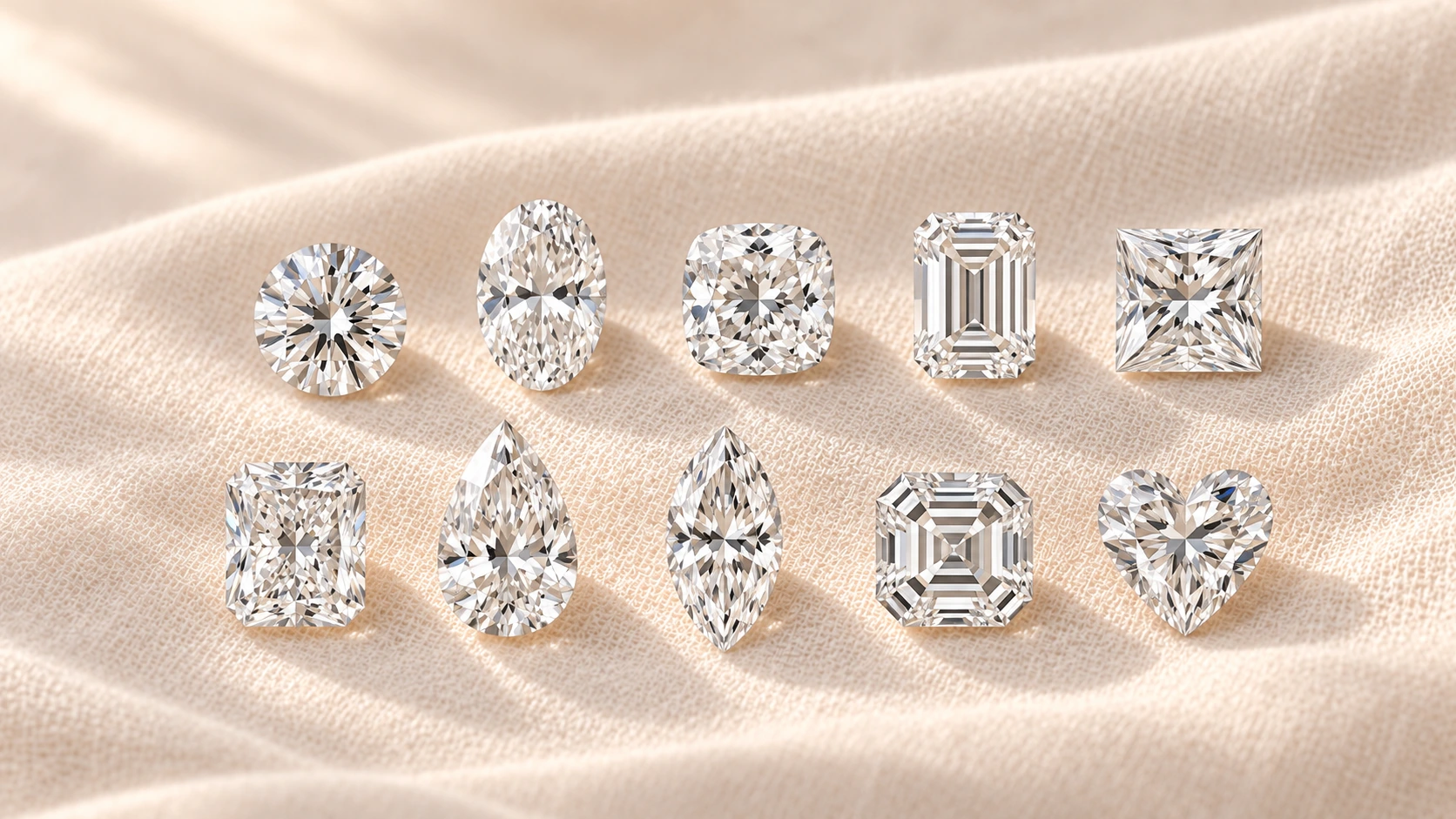
A diamond's facets act like small mirrors, so the stone picks up color from the metal around it. The shape matters too: some shapes show color more than a round does.
| Your ring | Lowest color we'd look at | Why |
|---|---|---|
| Round or oval in white gold or platinum, like our platinum oval engagement rings | G | White metal shows off a colorless stone, and near-colorless grades still look white in it |
| Pear, marquise or heart in white metal | F | These shapes tend to hold more color than a round |
| Emerald cut engagement rings and other step cuts | F | Step cuts sparkle less, so color is easier to see |
| Yellow gold, any shape, like our oval engagement rings in yellow gold | H | Yellow prongs reflect some yellow into any diamond, so a top color grade is harder to see |
| Rose gold, any shape, like our rose gold oval engagement rings | H | Colorless and near-colorless stones stand out against the pink metal |
At 1 carat, D to H cost about the same, so these floors matter most at 2 carats and up.
Match the color to the ring, and check who graded it
For a 1 carat lab grown diamond, pick any grade from D to H you like; the price barely moves. At 2 carats and up, G or H in white metal, or H in yellow or rose gold, saves a good share of the price for a difference that's hard to see. Step cuts and pointed shapes are worth a grade or two more.
Check which lab graded the color. IGI still grades lab grown diamonds on the D-to-Z scale. GIA stopped on 1 October 2025: a newer GIA report says Premium, which needs D color, or Standard, which covers E to J. So on a GIA report, an E and a J can carry the same word. There's more on that change in are lab grown diamonds worth it?
We sell every grade in this table, so we gain nothing from steering you to one. These numbers are for lab grown diamonds only. Mined diamonds have their own supply and their own price steps, so don't use these figures for a mined stone.
One more question
It can look fine, but in lab grown it's a pairing you'll rarely find. At I, any color is often unnoticeable to anyone but a trained grader, and VS2 inclusions almost never show without magnification. But we found only 13 I color stones at 1 carat, and at that size D to H, and VS1 or VS2, all cost about the same.