How to Choose a Wedding Band You'll Wear Every Day
Start with your hands, not the catalog. How each band style, metal, width, profile and finish wears over the years, and which bands are hard to resize later.
How do you choose a wedding band you'll wear every day for decades? Start with your hands, not the catalog. A band that looks perfect on a desk worker can pick up scuffs and dents fast on someone who lifts weights or works with tools. A band that can't be resized becomes a problem the day your fingers change. Work out how you use your hands and how much upkeep you'll put up with, and the metal, width, profile, finish and style mostly choose themselves.
This guide takes those choices one at a time and shows how each one wears over the years. If you also have an engagement ring, the band has to sit well beside it. That's its own question, covered in our guide to the engagement ring vs the wedding ring.
Which wedding band suits the way you use your hands
| Your hands and habits | Band style | Metal | Profile | Easy to resize later? |
|---|---|---|---|---|
| Desk work, gentle on your hands | Any, including pavé and eternity | Any | Any | Depends on the style |
| Tools, gym or heavy lifting | Plain, channel set or flush set | Platinum or 14K gold | Low dome | Plain bands usually are |
| Knuckles wider than the base of your finger | Any | Any | Comfort fit | Depends on the style |
| Nickel allergy | Any | Platinum or 18K yellow gold | Any | Depends on the style |
| You want the least upkeep | Plain | Platinum | Any | Usually |
| You want the most sparkle | Pavé or full eternity | Platinum or gold | Slim and low | Often hard; full eternity very hard |
| You expect your ring size to change | Plain | Gold or platinum, not tungsten | Any | Usually |
Hands that work hard raise a safety question too. A ring can catch on a tool or machine and injure the finger, and there's a simple fix for workdays. Both are in our guide to which hand a wedding ring goes on, along with when to take a ring off for the pool or household cleaners.
Plain, pavé, channel or eternity: how each one wears
The diamonds themselves aren't the weak point. Ours are lab grown, and a lab grown diamond is a diamond, as hard as a mined one. What wears is the metal that holds the stones, and each style holds them differently.
A plain band has nothing to lose and nothing to catch. Scratches can be polished out. It's also the band any good jeweler can make well, so if plain is all you want, shop wherever you like. Ours are on the plain gold wedding band page.
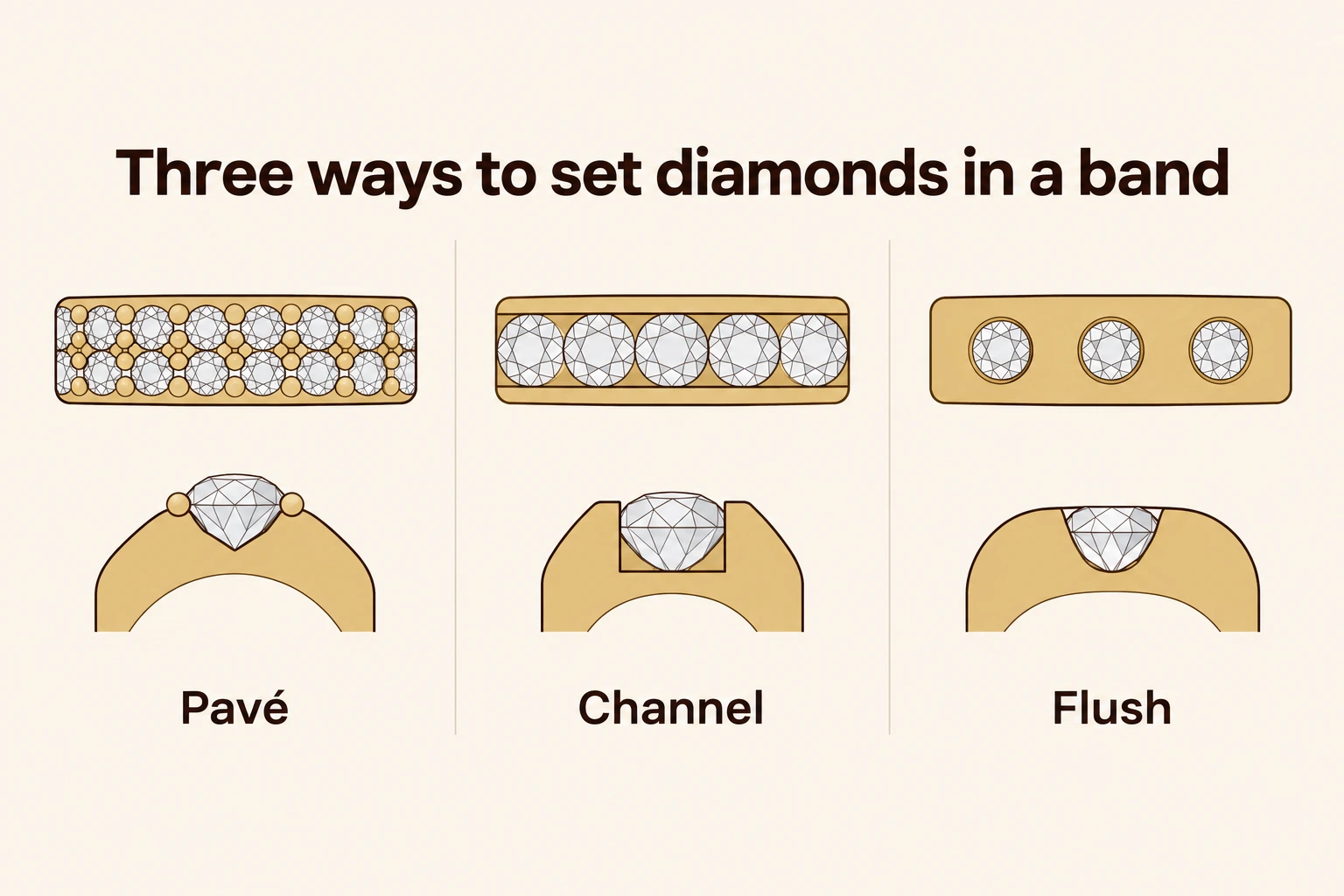
Pavé covers the top of the band in small diamonds, each held by tiny beads or prongs of metal. It gives the most sparkle a slim band can carry. The trade-off is that so little metal holds each stone that the diamonds can work loose on an active hand, so have a jeweler check them now and then. See our pavé wedding band page.
Channel set diamonds sit in a track between two walls of metal, with no prongs. The walls cover the edges of the stones, which makes a channel band a good choice for everyday wear and an active life. Compare it on our channel set wedding band page.
Flush and bezel set stones sit down in the band, level with the metal or ringed by a thin metal rim. The surface stays smooth, so the band rarely catches on clothes or gloves, and the metal shields the stones from chips.
Eternity bands carry stones all the way around (full eternity) or across the front only (half eternity). A full eternity band looks the same from every angle, which is why it's the classic band to stack. Its catch is sizing, covered below. Browse our diamond eternity bands.
Metal is really a choice about upkeep
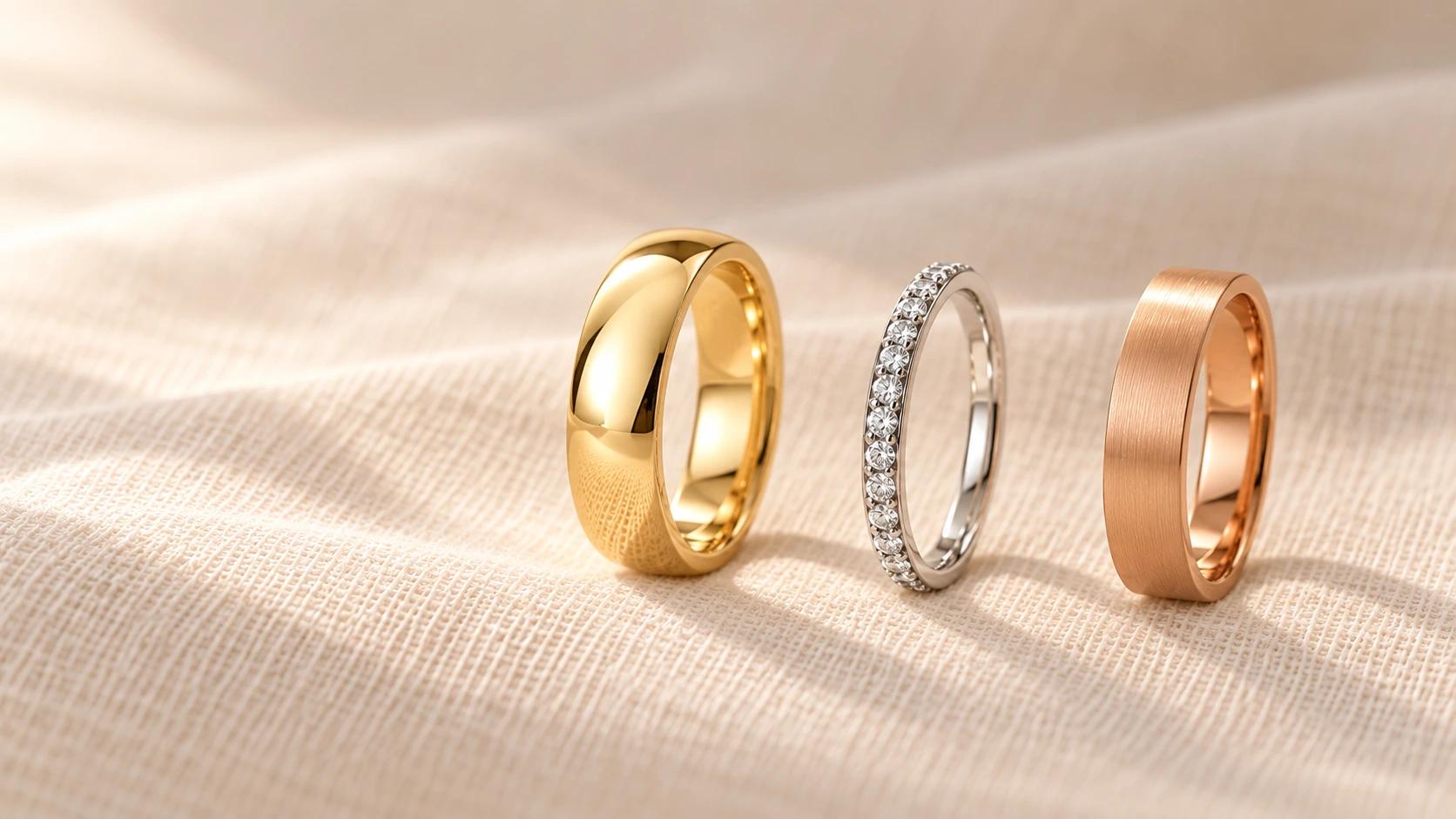
We make bands in platinum and in 14K or 18K gold, in yellow, white and rose. What differs is what each one asks of you over the years.
| Metal | How it wears | Upkeep over the years |
|---|---|---|
| Platinum | Naturally white. A scratch pushes the metal aside instead of wearing it away, and with time the surface takes on a soft satin look called a patina. | Nothing to replate. Polish it back to a shine if you prefer that. Usually costs more than gold. |
| White gold | Gets its bright white from a thin rhodium plating that slowly wears away. As it thins, the band starts to look warmer. | Replate every so often. Some white gold alloys contain nickel. |
| Yellow gold | The color runs all the way through the metal. | No plating to redo. Scratches polish out. |
| Rose gold | The pink color comes from copper in the alloy. | No plating to redo. Skip it if copper irritates your skin. |
14K or 18K? 14K is 58.3% gold and 18K is 75%. The rest is harder alloy metal, so 18K is a little softer, and 14K stands up slightly better to everyday knocks. 18K costs more because it holds more gold.
If your skin reacts to nickel, you're not unusual: more than 18% of people in North America are allergic to it. Dermatologists list platinum and yellow gold of 18K or higher among the safer choices. White gold is the one to check, so ask us which alloy a white gold band uses before you order.
Wearing a band in a different metal from your engagement ring is fine. Our engagement ring vs wedding ring guide covers the one thing to watch when the two rub together. For a warm, classic look, see our yellow gold wedding band page.
Width and profile decide how it feels
Width is how wide the band looks from above, measured in millimeters. Women's wedding bands are most often 2 to 5 mm wide, and men's tend to be wider. A wider band covers more of the finger and fits more snugly, so it usually needs a slightly bigger size than a narrow one. Each of our bands has its own width, shown on its page. If you want a width we don't list, ask us about a custom order. How a band's width works next to an engagement ring is a separate choice, covered in the same guide to the engagement ring and the wedding ring linked above.
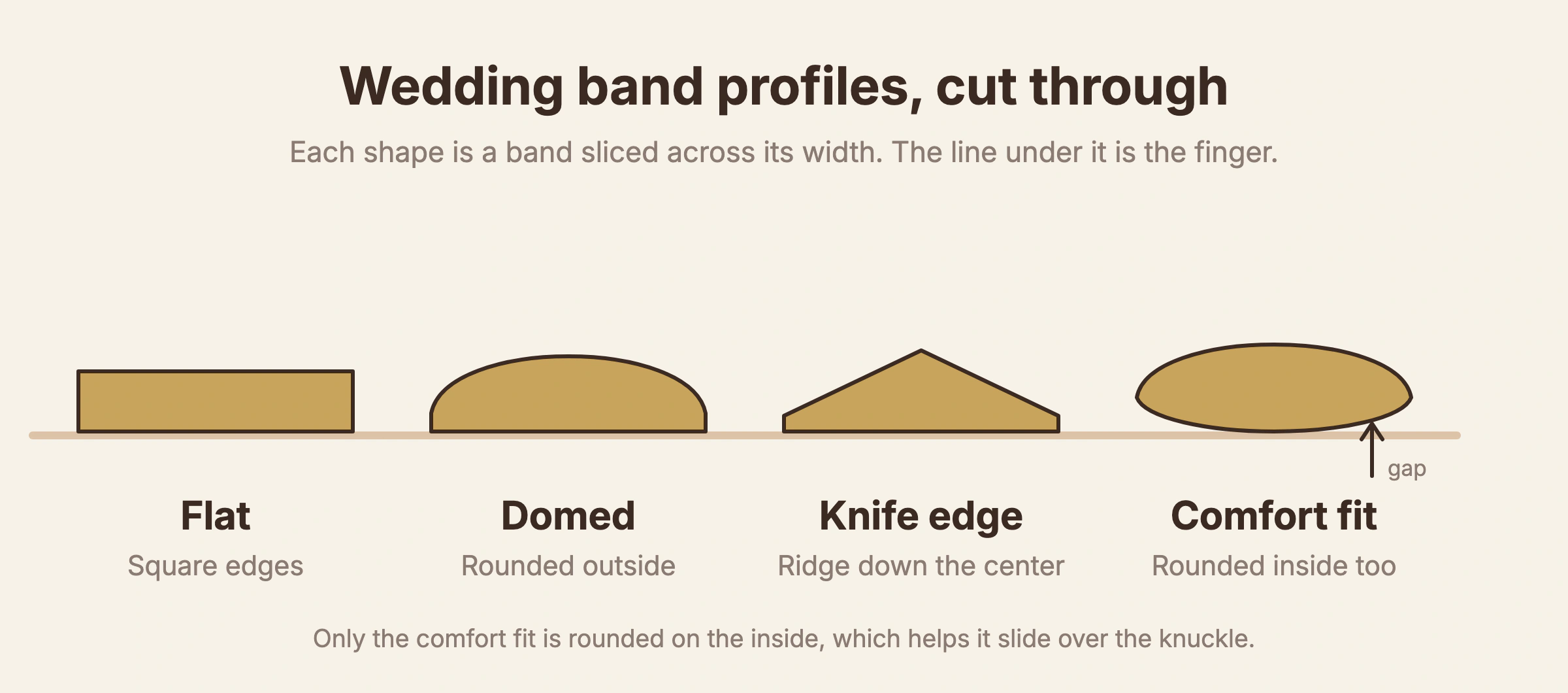
Profile is the shape of the band when you cut it straight through. It changes how the band looks from the side and how it feels between your fingers:
- Flat: flat outside and flat inside, with square edges. Crisp and modern.
- Domed: rounded on the outside, like the letter D. A low dome is light and smooth, which is why it's the classic everyday shape.
- Knife edge: the two sides rise to a thin ridge along the center, so the band looks slimmer from above than it really is.
- Comfort fit: rounded on the inside as well, so it slides over the knuckle more easily. It's a choice about the inside of the band, so it can go with a flat or a domed outside.
Polished, brushed or hammered
The finish is the texture on the surface of the metal, and it decides how the band looks after a year of wear.
- High polish is a mirror shine. It's the brightest finish, and it's also the one that shows every fine scratch. Scratches on a band you wear every day are normal, and a jeweler can polish most of them out.
- Brushed or satin is covered in fine lines that give a soft, low sheen. Because the surface is already textured, small new scratches blend in.
- Hammered has small flat dents across the surface, like beaten metal. It hides everyday wear well and has a handmade look.
Platinum brings its own twist: its natural patina is a satin look, so a polished platinum band will drift that way unless you have it polished again. Each of our bands comes with its own finish, shown on its page, and a custom order can change it.
Men's bands: the same questions, different habits
A man's band gets chosen the same way: hands first, then metal, width, profile and finish. The main difference is that many men wear the band on its own, without an engagement ring beside it. The width and profile can then suit his hand alone, with no fit to worry about.
We sell men's bands, including plain bands in men's widths and sizes, in gold and platinum. We don't make tungsten, titanium or cobalt bands. They're popular for men because they're hard and resist scratches, and some cost less than gold or platinum. They come with trade-offs too. Tungsten and titanium are hard or impossible to resize (see the table below), and tungsten is brittle and can crack under a hard knock. It can't be cut off with a standard ring cutter; in an emergency it has to be cracked off with pliers. If he wants one of these anyway, buy it elsewhere with those limits in mind.
Getting the size right for both of you
Couples usually shop for their bands together. Make it one trip: get both of you sized on the same day, each on the finger the band will be worn on, and in the width you plan to buy. Our guide to which hand a wedding ring goes on explains how a ring should fit. For how far ahead to start, see our engagement ring vs wedding ring guide.
Buying your partner's band as a surprise is harder. Borrow a ring they wear on the ring finger of that same hand. A ring from the other hand can be about half a size off.
The size matters more for some bands than others, because not every band can be changed later:
| Band | Can it be resized later? |
|---|---|
| Plain gold or platinum | Usually, and it's the simplest to work on |
| Pavé | Harder, because bending the band can disturb the small stones |
| Channel set | Can be hard, more so when the stones run far around the band |
| Full eternity | Very difficult, because there's no plain metal to work with |
| Titanium | Hard to resize |
| Tungsten | Can't be resized |
Whether one of our bands can be resized depends on its design, so ask us before you order. Eligible rings get one free resize within 30 days of delivery. Resized and engraved pieces are final sale, so wait until the fit is right before you add an engraving.
Common questions
No. There's no rule that two partners' bands share a metal, a width or a style. Some couples match one detail, such as the metal or the finish, and let each width suit its own hand. Others choose completely different bands. Pick the band that suits each wearer's hands and habits first, and the pair will look right together.
Yes. We take custom orders, so if you want a width, profile, finish or metal we don't list, ask us. Two things to plan for: custom pieces are final sale, so settle the size and design before you order, and a custom band takes longer to make than a ready-made one, so start early.