Diamond Size Chart: What Each Carat Measures, Shape by Shape
How big is a 1 carat diamond? We measured lab grown diamonds listed for sale online in the US: carat to mm for 10 shapes, from half a carat to 5 carats.

A 1 carat round diamond is about 6.5 mm across, and a 1 carat oval is about 8.2 by 5.7 mm. Double the weight and the round grows to about 8.2 mm: a quarter wider, not twice as wide.
This diamond size chart comes from measuring 695,045 lab grown diamonds listed for sale online in the US, not from an ideal-cut formula. Below: every weight from half a carat to 5 carats in 10 shapes, which shape looks biggest for its weight, and how each size looks on a finger.
Round diamond size chart: carat to mm
"Across" is the median diameter: the stone halfway down the list when all of them are lined up by size. The middle half shows where most stones fall, from the one a quarter of the way down the list to the one three quarters down.
| Carat | Across (median) | Middle half of stones | Face-up area | Face-up area vs 1 carat |
|---|---|---|---|---|
| 0.5 carat | 5.21 mm | 5.17–5.27 mm | 21.3 mm² | 64% |
| 1 carat | 6.51 mm | 6.48–6.58 mm | 33.3 mm² | 100% |
| 1.5 carat | 7.41 mm | 7.39–7.48 mm | 43.1 mm² | 130% |
| 2 carat | 8.15 mm | 8.12–8.21 mm | 52.1 mm² | 157% |
| 2.5 carat | 8.77 mm | 8.74–8.84 mm | 60.4 mm² | 181% |
| 3 carat | 9.31 mm | 9.29–9.37 mm | 68.0 mm² | 205% |
| 4 carat | 10.21 mm | 10.19–10.30 mm | 81.9 mm² | 246% |
| 5 carat | 11.00 mm | 10.95–11.09 mm | 95.0 mm² | 286% |
Each row is a narrow weight band: "1 carat" means 1.00 to 1.09 carats, "2 carat" means 2.00 to 2.09, and so on. Face-up area is the part you see from above.

Fancy shapes, carat to mm
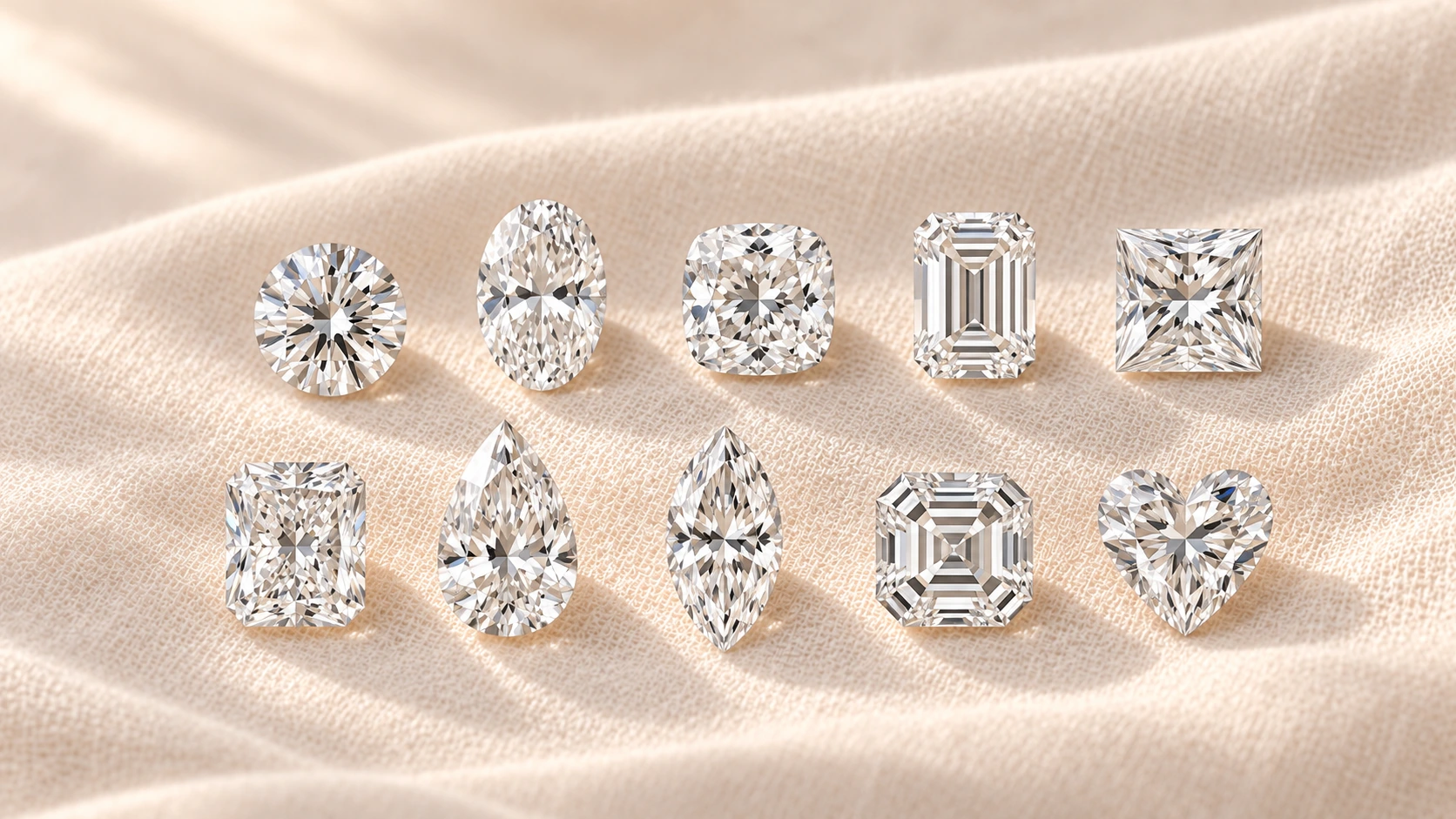
Every shape except round is a fancy shape. The tables give the median length × width in mm, rounded to 0.1 mm. Length runs from tip to tip, or along the long side.
Long shapes
| Carat | Oval | Pear | Marquise | Emerald | Cushion, elongated | Radiant, elongated |
|---|---|---|---|---|---|---|
| 0.5 ct | 6.7 × 4.6 | 7.4 × 4.5 | 8.4 × 4.2 * | 5.7 × 3.8 | — | 5.8 × 4.0 |
| 1 ct | 8.2 × 5.7 | 9.0 × 5.7 | 10.5 × 5.3 | 6.9 × 4.8 | 7.0 × 5.3 | 7.2 × 5.0 |
| 1.5 ct | 9.3 × 6.5 | 10.2 × 6.5 | 11.8 × 6.0 | 7.8 × 5.4 | 8.0 × 6.0 | 8.2 × 5.7 |
| 2 ct | 10.2 × 7.2 | 11.2 × 7.1 | 13.0 × 6.6 | 8.6 × 6.0 | 8.9 × 6.6 | 9.0 × 6.3 |
| 2.5 ct | 11.0 × 7.7 | 12.0 × 7.6 | 14.1 × 7.1 | 9.3 × 6.4 | 9.5 × 7.1 | 9.7 × 6.7 |
| 3 ct | 11.6 × 8.2 | 12.7 × 8.1 | 14.9 × 7.5 | 9.8 × 6.8 | 10.0 × 7.6 | 10.3 × 7.2 |
| 4 ct | 12.8 × 9.0 | 14.1 × 8.9 | 16.4 × 8.3 | 10.7 × 7.5 | 11.0 × 8.3 | 11.2 × 7.9 |
| 5 ct | 13.8 × 9.7 | 15.1 × 9.6 | 17.8 × 8.9 | 11.6 × 8.1 | 11.9 × 9.0 | 12.1 × 8.5 |
Square shapes and heart
| Carat | Princess | Asscher | Cushion, square | Radiant, square | Heart |
|---|---|---|---|---|---|
| 0.5 ct | 4.5 × 4.4 | 4.5 × 4.5 * | 4.7 × 4.7 * | — | 5.1 × 5.6 * |
| 1 ct | 5.6 × 5.5 | 5.6 × 5.6 | 5.9 × 5.8 | 5.7 × 5.5 * | 6.3 × 7.0 |
| 1.5 ct | 6.3 × 6.3 | 6.4 × 6.3 | 6.7 × 6.6 | 6.6 × 6.4 | 7.1 × 8.0 |
| 2 ct | 7.0 × 6.9 | 7.0 × 6.9 | 7.4 × 7.3 | 7.1 × 6.9 | 7.8 × 8.8 |
| 2.5 ct | 7.5 × 7.4 | 7.5 × 7.5 | 7.9 × 7.8 | 7.7 × 7.5 | 8.4 × 9.5 |
| 3 ct | 7.9 × 7.8 | 8.0 × 7.9 | 8.5 × 8.3 | 8.2 × 8.1 | 8.9 × 10.1 |
| 4 ct | 8.7 × 8.6 | 8.8 × 8.7 | 9.3 × 9.2 | 8.8 × 8.6 * | 9.9 × 11.0 |
| 5 ct | 9.4 × 9.3 | 9.5 × 9.4 | 10.0 × 9.8 | 9.5 × 9.3 * | 10.7 × 11.8 |
Cells marked * are small samples, under 100 stones. A dash means fewer than 10 stones, too few to show. Hearts are listed wider than they are long, so in the heart column the second number is the bigger one. Most radiants listed for sale are elongated: at 1 carat we counted 67 square ones against 7,473 long ones.
What we checked
- When: 28 September 2026, one day's listings
- Stones: 695,045 lab grown diamonds listed for sale online in the US in the eight weight bands above, from 16 stones (square cushion and asscher at half a carat) to 102,839 (round at 1 carat)
- Held the same: D to H color, VS2 clarity or better, a GIA or IGI report. Color and clarity don't change a stone's size, so we kept this band wide
- Weights: 0.50–0.59, 1.00–1.09, 1.50–1.59, 2.00–2.09, 2.50–2.59, 3.00–3.09, 4.00–4.09 and 5.00–5.09 carats
- How: for each shape and weight, the median length and the median width, where the median is the stone halfway down the list. For round and oval we also found the middle half
- Cushion and radiant: split into square (length no more than 1.10 times the width) and elongated (1.20 times or more), because one number for both would describe neither
- Limits: these are stones listed on one day, not every diamond made. Face-up area is given only for round and oval, whose outlines are true circles and ellipses. For the other shapes the outline is harder to measure, so we give length × width instead
Twice the weight isn't twice the size
A carat is a unit of weight, 0.2 grams, not a measure of size. Weight fills a diamond's length, width and depth all at once. So when the weight doubles, each of those three grows by only about a quarter.
The round chart shows it clearly. A 2 carat round is 8.15 mm across, 25% wider than a 1 carat at 6.51 mm. Seen from above, it shows 57% more diamond, not 100% more. A 3 carat round is 43% wider than a 1 carat and shows about twice the face-up area, for three times the weight.
Each step up the scale adds less width than the one before. Going from half a carat to 1 carat adds 25% to the width. From 1 to 1.5 carats adds 14%, from 1.5 to 2 adds 10%, and from 2.5 to 3 adds just 6%.
Which shape looks biggest for its weight
It depends on whether you mean length or the whole outline. This table compares each shape with a round of the same weight, at 1 carat.
| Shape (1 carat) | Length vs round | Width vs round |
|---|---|---|
| Marquise | 161% | 81% |
| Pear | 138% | 87% |
| Oval | 126% | 88% |
| Radiant, elongated | 111% | 77% |
| Cushion, elongated | 108% | 81% |
| Emerald | 106% | 74% |
| Heart | 97% | 108% |
| Cushion, square | 91% | 89% |
| Radiant, square | 88% * | 85% * |
| Asscher | 86% | 85% |
| Princess | 85% | 84% |
At 2 carats every figure stays within two points of these.
A marquise is the longest shape by far, 61% longer than a round, but it's also 19% narrower. Long shapes win on length much more than on total size. An oval is the clearest example because its outline is an exact ellipse: it's 26% longer than a round of the same weight, yet it shows only about 11% more face-up area.
Square shapes go the other way. A princess or an asscher is about 15% smaller than a round in both directions. A square has corners that a circle doesn't, and those corners carry weight that would otherwise go into width.
If you want a stone that looks long on the finger, choose a marquise, pear or oval. Fancy shapes cost more than round for lab grown diamonds, though; we compared that in which diamond shape costs the most.
Read the millimeters on the report, not only the carats
Most rounds of the same weight measure almost the same. Half of all 1 carat rounds we counted fall between 6.48 and 6.58 mm, a spread of a tenth of a millimeter. Ovals vary more, because their proportions vary more: the middle half of 1 carat ovals runs from 8.03 to 8.33 mm long.
The stones outside that middle half are where it pays to look closely. A deep, poorly cut diamond hides extra weight below its widest edge, the girdle, where you can't see it once the stone is set. A badly cut 1.20 carat diamond can look no bigger than a well cut 1 carat. A grading report lists the length, width and depth in mm, so compare those alongside the weight.
The same logic works in your favor just under a round number. A 1.90 to 1.99 carat round measures about 7.99 mm, only 2% narrower than a 2 carat at 8.15 mm. That's a gap of 0.16 mm across the whole stone, for about 5% less weight.
How big each size looks on a finger
A stone's size on the hand depends on the finger as well. This table shows the stone's width as a share of the finger's width, using the inside diameter of the ring as the finger width. For an oval set lengthwise, the width is the part that crosses the finger.
| Stone | US size 4 (14.9 mm) | Size 5 (15.7 mm) | Size 6 (16.5 mm) | Size 7 (17.3 mm) | Size 8 (18.1 mm) |
|---|---|---|---|---|---|
| 1 carat round (6.5 mm) | 44% | 41% | 39% | 38% | 36% |
| 1 carat oval (5.7 mm wide) | 38% | 36% | 35% | 33% | 32% |
| 1.5 carat round (7.4 mm) | 50% | 47% | 45% | 43% | 41% |
| 1.5 carat oval (6.5 mm wide) | 44% | 42% | 40% | 38% | 36% |
| 2 carat round (8.2 mm) | 55% | 52% | 49% | 47% | 45% |
| 2 carat oval (7.2 mm wide) | 48% | 46% | 43% | 41% | 40% |
| 3 carat round (9.3 mm) | 62% | 59% | 56% | 54% | 51% |
| 3 carat oval (8.2 mm wide) | 55% | 52% | 50% | 47% | 45% |
The same stone looks bigger on a slim finger. A 1 carat round on a size 4 covers 44% of the finger, almost exactly what a 2 carat round covers on a size 8. So if you're choosing for someone with slender hands, a smaller weight may already give the look you want. An oval covers less of the finger's width than a round of the same weight, but it runs further along it.
Shop by millimeters and shape
Start from the size you want to see, then find the weight that gives it in your shape. If a 7.5 mm round is the goal, the chart points you to about 1.5 carats. If you want length, an oval of the same weight reaches about 9.3 mm. You can compare stones and settings in our round engagement rings or go straight to the carat pages linked in the round table.
We sell only lab grown diamonds, but this chart works just as well for a mined diamond. A diamond has the same density whether it was grown or mined, with a specific gravity of about 3.52, so a stone of the same weight and proportions measures the same. We didn't measure mined stones, so if you're buying one, check its own grading report for the mm.
Common questions
Usually each stone is about half a carat. Studs are normally sold by total carat weight, both stones added together, so a "1 carat" pair of rounds holds two stones about 5.2 mm across. A full carat in each ear is sold as 2 carats total. Compare pairs in our lab grown diamond stud earrings.
Read the grading report. The lab weighs the loose stone on a very precise scale and prints the weight to two decimal places, next to its length, width and depth in mm. Once a diamond is set, a jeweler can only estimate its weight from those measurements, and a deep stone hides weight, so the estimate can be off.