Diamond Shapes Explained: 10 Shapes Compared on Price, Size and Popularity
Ten diamond shapes, side by side: what each measures at 1 carat, how its price compares with round for lab grown, how many couples choose it, and what to check before you buy.
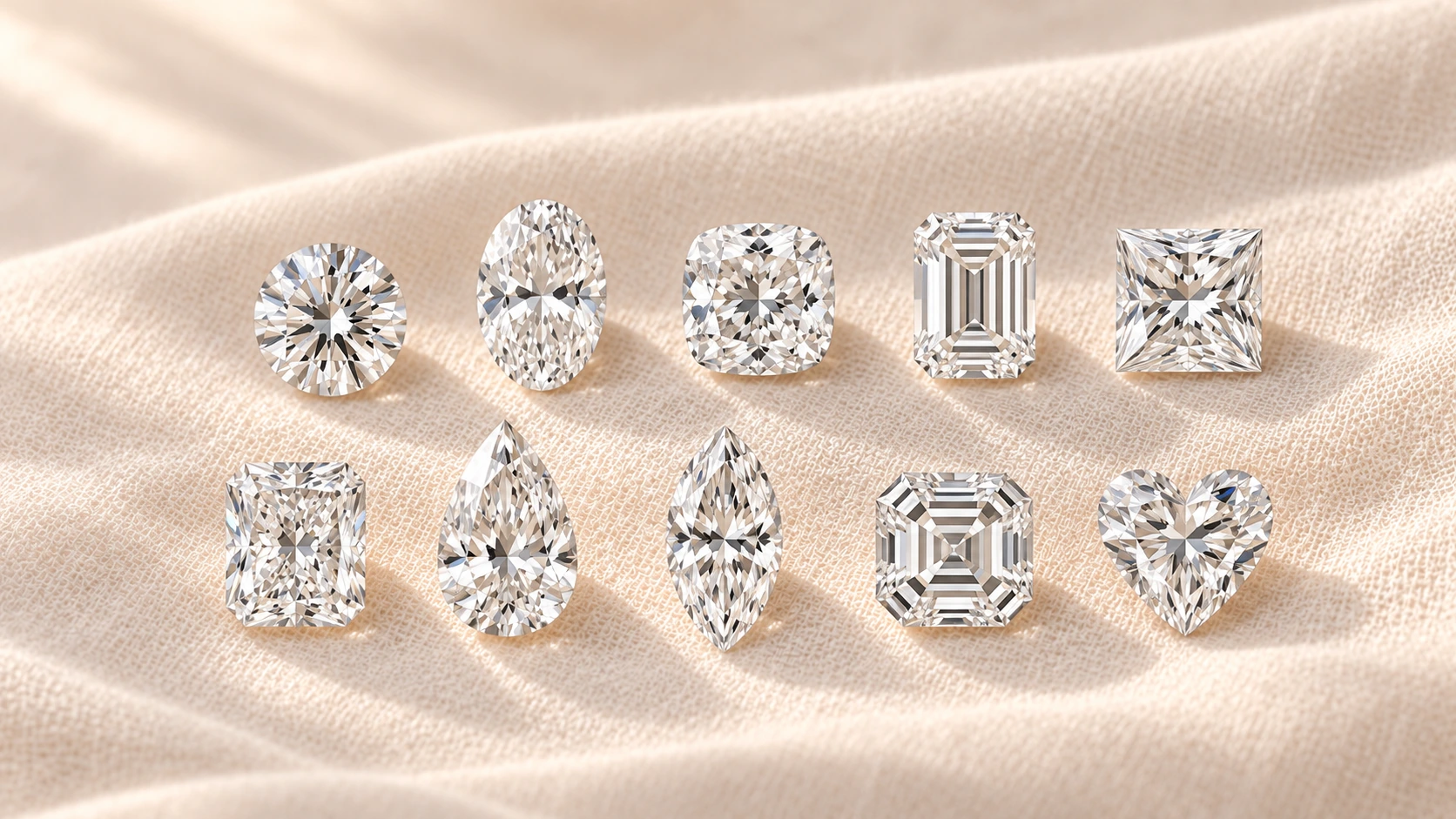
The diamond shapes you'll see most often are round, oval, cushion, emerald, princess, radiant, pear, marquise, asscher and heart. Those are the ten in this guide. Other cuts exist, such as the triangular trillion and the long, thin baguette, but they're mostly used as small side stones.
Round and oval are almost tied as the most chosen: a 2026 survey of more than 10,000 US couples put round at 26% and oval at 25%. For lab grown diamonds, round is also the cheapest shape, and the long shapes look the biggest for their weight. Below, all ten sit in one table with their price, measured size and popularity, followed by what to check for each and a way to choose.
A diamond's shape is its outline seen from above. Its cut style is how the facets, the small flat surfaces, are arranged on it. That's why two shapes can share an outline and still look different.
The 10 diamond shapes compared
| Shape | Facet style | Size at 1 carat | Longest side vs round | Price vs round, 1 carat / 2 carats | Share of couples |
|---|---|---|---|---|---|
| Round | Brilliant | 6.5 mm across | 100% | 100% / 100% | 26% |
| Oval | Brilliant | 8.2 × 5.7 mm | 126% | 116% / 111% | 25% |
| Pear | Brilliant | 9.0 × 5.7 mm | 138% | 126% / 111% | 8% |
| Marquise | Brilliant | 10.5 × 5.3 mm | 161% | 130% / 117% | 8% |
| Princess | Brilliant | 5.6 × 5.5 mm | 85% | 123% * / 113% | 8% |
| Cushion | Brilliant | square 5.9 × 5.8 mm · elongated 7.0 × 5.3 mm | 91% · 108% | 124% / 112% | 6% |
| Radiant | Brilliant | elongated 7.2 × 5.0 mm | 111% | 128% / 112% | 6% |
| Emerald | Step | 6.9 × 4.8 mm | 106% | 122% / 111% | 8% |
| Asscher | Step | 5.6 × 5.6 mm | 86% | 129% * / 116% * | not reported |
| Heart | Brilliant | 6.3 long × 7.0 mm wide | 108% (its width) | 131% / 110% | not reported |
Sizes are the median 1 carat stone, and "longest side" compares a shape's length with a round's 6.5 mm diameter. Prices are for lab grown diamonds of the same grade, F color and VS1 clarity. Prices marked * come from small samples, under 100 stones. Cushion and radiant prices cover square and elongated stones together. The survey didn't report asscher or heart on their own.

What we checked
- Prices: 28 September 2026, one day's listings. 10,403 lab grown diamonds listed for sale online in the US, 4,051 at 1 carat and 6,352 at 2 carats, all F color, VS1 clarity, with a GIA or IGI report. For each shape we took the median asking price, the stone halfway down the list from cheapest to dearest
- Sizes: the same day, 205,320 lab grown diamonds of 1.00 to 1.09 carats, D to H color, VS2 or better. For each shape, the median length and the median width. Cushions and radiants were split into square (length no more than 1.10 times the width) and elongated (1.20 times or more)
- Popularity: a 2026 survey of more than 10,000 US couples who married in 2025
- Limits: these are asking prices, not what buyers finally paid, and stones listed on one day, not every diamond made. The asscher prices, and the princess price at 1 carat, come from fewer than 100 stones each
Round is the benchmark, and the cheapest for lab grown
Every other shape in this guide is measured against round, and for good reason. It's known as the brightest of all diamond cuts. It's also the only shape that gets an overall cut grade on a grading report, on a scale from Excellent to Poor, so it's the easiest shape to judge on paper.
For lab grown diamonds, round is also the cheapest shape. At the same grade, every other shape cost 16 to 31% more at 1 carat and 10 to 17% more at 2 carats. Most shape guides say the opposite, because they're written about mined diamonds. We looked at why in which diamond shape costs the most.
Round is by far the easiest shape to find, too. Half of the 1 carat lab grown diamonds listed for sale were round, 102,839 stones in all, so you'll have the widest choice of round engagement rings.
Oval, pear and marquise look the biggest for their weight
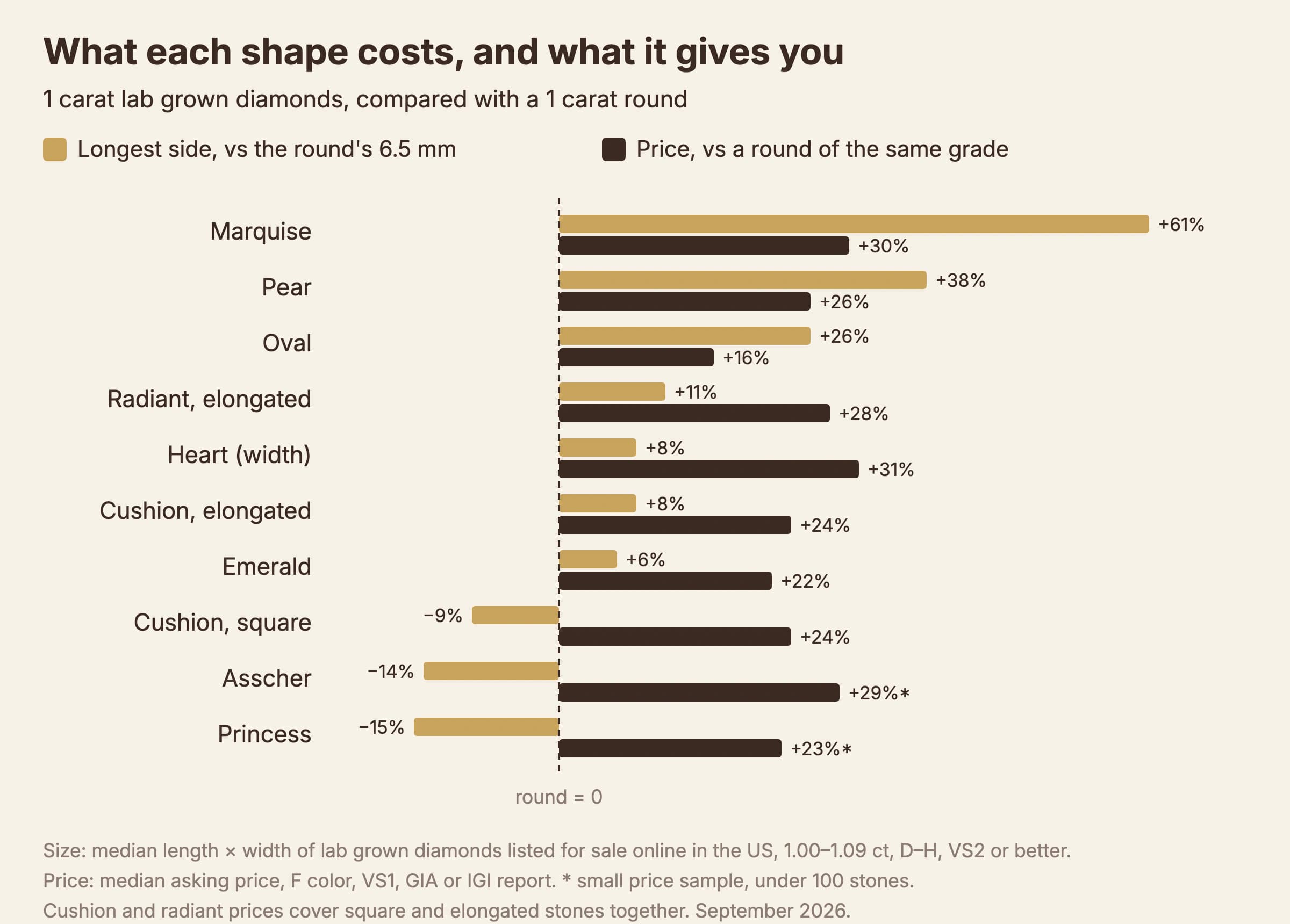
These three stretch the same weight into a longer outline. They're narrower than a round, though, so what you gain is mostly length. An oval shows it best, because its outline is an exact ellipse, so its area is easy to work out: 26% longer than a round of the same weight, but only about 11% more diamond seen from above. Our diamond size chart gives the typical size of every shape from half a carat to 5 carats.
All three can show a bow tie, a dark band across the middle shaped like a bow tie. It comes from the way a stretched outline steers light through the facets. Some are faint, some form a solid dark bar, and some fade as the stone moves. A grading report won't show it, but a video will.
Oval is the lab grown favorite. In the survey it was the most common center stone among couples who chose lab grown, while round led among mined stones. It has no points to protect, and of the long shapes it costs the least extra: 16% more than a round at 1 carat, 11% at 2. You can compare loose oval lab grown diamonds side by side.
A pear is rounded at one end and pointed at the other. At 9.0 × 5.7 mm it's as wide as a 1 carat oval but nearly a millimeter longer. Its tip is the weak spot, since a point can chip if it takes a knock. Look for a prong or a bezel that covers it.
For sheer length, nothing beats the marquise. At 1 carat it's 61% longer than a round's diameter and costs 30% more, the most length for the extra money of any shape. It's also slim, only 5.3 mm across at 1 carat, and pointed at both ends, so it needs both tips protected, usually with V-shaped prongs. Browse loose marquise lab grown diamonds.
Princess, cushion and radiant: square corners, brilliant sparkle
These three have brilliant facets, the many small triangles and kite shapes that break light into sparkle, set inside a square or rectangular outline. What tells them apart is the corners. A princess has sharp, pointed corners. A cushion has rounded ones. A radiant's corners are cut off.
Squares come out smaller than a round of the same weight, because their corners carry weight that would otherwise go into width. That's worth knowing before you compare prices, since all three still cost more than round.
The princess is the most compact: 5.6 × 5.5 mm at 1 carat, about 15% smaller across than a round. It cost 23% more than a round at 1 carat, from a small sample, and 13% more at 2 carats. Its corners sit close to a weak plane in the crystal, so they chip more easily than the rest of the stone. V-shaped prongs over each corner guard them. See our princess cut engagement rings.
Cushions come in two proportions that measure very differently. A square one is 5.9 × 5.8 mm at 1 carat, a little smaller than a round. An elongated one is 7.0 × 5.3 mm, about 8% longer. Divide the length by the width on the report: close to 1.0 means square, 1.2 or more means elongated. For the longer look, see elongated cushion cut engagement rings, or compare loose cushion lab grown diamonds.
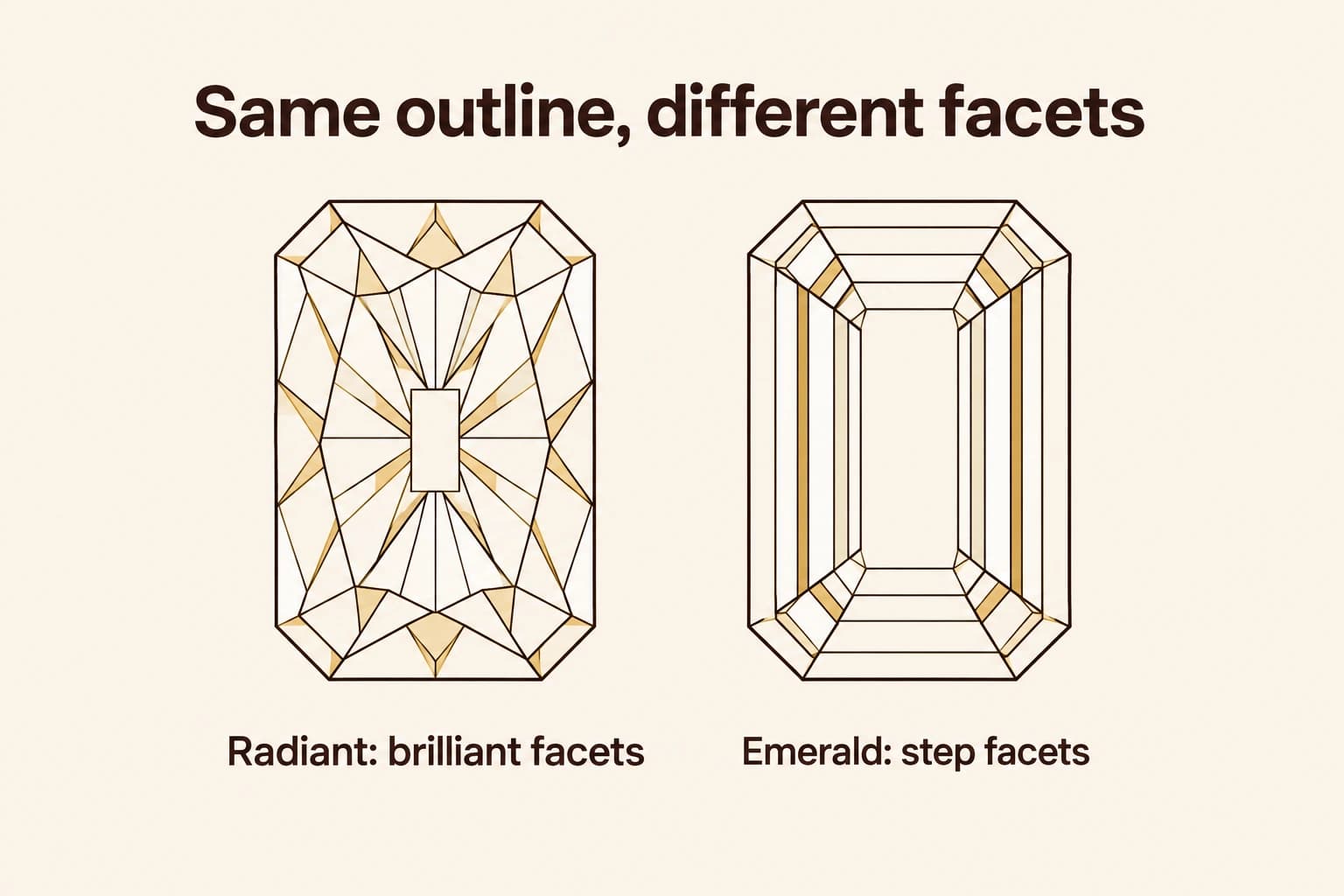
Almost every radiant listed for sale is elongated. At 1 carat there were 67 square radiants listed against 7,473 long ones. The shape borrows an emerald cut's outline and gives it brilliant sparkle. At 1 carat it cost 28% more than a round, one of the bigger gaps, but at 2 carats only 12% more.
The radiant and the emerald cut are the clearest case of shape and cut style being two different things:
Emerald and asscher are step cuts, and they show more
Step cuts have long, flat facets in rows that run parallel to the edges, like stairs. Instead of sparkle, they give broad flashes of light, a look often called a hall of mirrors. Those open facets work like windows. Inclusions show more easily than in a brilliant cut, and so does color, because there's less sparkle to hide it. Plan on a higher clarity than you'd accept in a round, and look at color closely.
The emerald cut is the long one, 6.9 × 4.8 mm at 1 carat. It's only 6% longer than a round and much narrower, so unlike an oval it doesn't look bigger for its weight. People choose it for the look, not the size. It cost 22% more than a round at 1 carat and 11% more at 2. Compare loose emerald lab grown diamonds.
An asscher is the square step cut, with corners cut so deeply that it looks nearly octagonal. Its deep lower half and layered facets draw the eye down into the center. It's also the hardest shape on this list to find: 2,772 stones at 1 carat, about 1 in 75 of those listed, and only 35 at our price grade. So treat its price figures as rough. You'll find settings made for it in our asscher engagement rings.
A heart needs some size to read as a heart
A heart is usually wider than it is long. At 1 carat, the median heart measured 6.3 mm long and 7.0 mm wide. Both halves should match, with a clean cleft at the top and a sharp point at the bottom. Below about half a carat, the heart shape is hard to make out at all.
Its prices move more than most. A heart cost the most of any shape at 1 carat, 31% more than a round, yet the least of the fancy shapes at 2 carats, just 10% more. It isn't scarce either: 10,431 were listed at 1 carat, more than emerald or princess. Like a pear, it has one point to protect, so choose a setting that covers the tip.
Put the price and the size of each shape side by side, and only the long shapes give you more length than they cost you:
How to choose a diamond shape: start with what matters most
There's no best diamond shape, only the best one for what you care about most. If that's price, round wins for lab grown. If it's looking big, go long: marquise, pear or oval. If it's a clean, glassy look, choose a step cut and buy a higher clarity. The table matches each priority to shapes and to what to check.
| What matters most | Shapes to look at | What to check |
|---|---|---|
| The lowest price for the grade | Round | The cut grade, since round is the only shape that has one. Aim for Excellent |
| Looking big for the weight | Marquise, pear, oval | A bow tie in the video; prongs or a bezel over the tips of a marquise or pear |
| Length without paying much extra | Oval | The length and width on the report, to see how long it really is |
| Sparkle | Round, then any brilliant shape | Emerald and asscher give flashes instead, so skip them if sparkle is the point |
| A clean, glassy look | Emerald, asscher | A higher clarity than you'd need in a round, and color, which shows more |
| Hands-on work or sports | Round, oval, cushion | Nothing pointed to chip. A bezel setting, which rings the stone in metal, catches less on gloves and fabric |
| Something less common | Asscher, heart | Asscher: fewer stones to choose from. Heart: at least half a carat, with both halves matching |
We sell all ten shapes, so we don't gain anything by steering you toward one. If the lowest price is what matters, the honest answer is round: every shape that looks bigger costs more for the same weight and grade. And these numbers are for lab grown diamonds only. Mined diamonds price their shapes differently, so don't use them to judge a mined stone.
Once you've picked a shape, the table at the top links to the engagement rings made for it.
One more shape question
Yes, but it always loses weight. The new outline has to fit inside the old stone, and everything outside it is ground away. In one documented case, a round of more than 6 carats was recut into a radiant of 4.61 carats. It also needs a new grading report, because its shape, measurements and weight have all changed.