How Much to Spend on an Engagement Ring (and Where the Money Goes)
There's no right amount. How to set a ring budget you can pay without borrowing, where the salary rule came from, and what each diamond choice does to the price.
There's no right amount to spend on an engagement ring. Spend what you can pay for with money you already have, or can save before you buy, without borrowing. The "three months' salary" rule you may have heard didn't come from anyone's financial advice. It came from a diamond company's advertising.
That still leaves the real question: how much should an engagement ring cost for you? This guide gives you a way to set the number, a sense of what other people spend, and a clear view of where the money goes once you start choosing a diamond.
Where the salary rule came from
In the middle of the 20th century, a diamond company ran advertising that linked the size of a diamond to the size of your love. Decades later, the same company's campaigns named a price point: a set number of months' salary. The line stuck, and it still gets repeated as if it were a rule. It isn't. It was a sales message, and it takes no account of your savings, your debts or what your partner actually wants.
What people typically spend
A large annual survey of US couples puts the average engagement ring at about 5½% of a typical American household's income for a year, before tax. That's just under three weeks of that household's pay.
Treat that as a rough guide, not a target. An average can be pulled up by a small number of very expensive rings, and your finances are yours, not the survey's.
How to set your number
Start with money, not with rings.
- What you have now. How much of your savings could go to a ring without touching your emergency fund?
- What you can add. How much could you set aside from each paycheck, and for how many months before you'd like to propose?
- Add them up. That gives you a budget and a date. If the ring you have in mind costs more, you can wait longer, or choose differently using the table below.
Don't borrow for it. A ring that starts your married life with debt isn't much of a gift. That includes buy now, pay later plans, which are a loan by another name. If you do use one with us, note that returns on those orders are limited to 14 days, not the usual 30.
Where the money goes
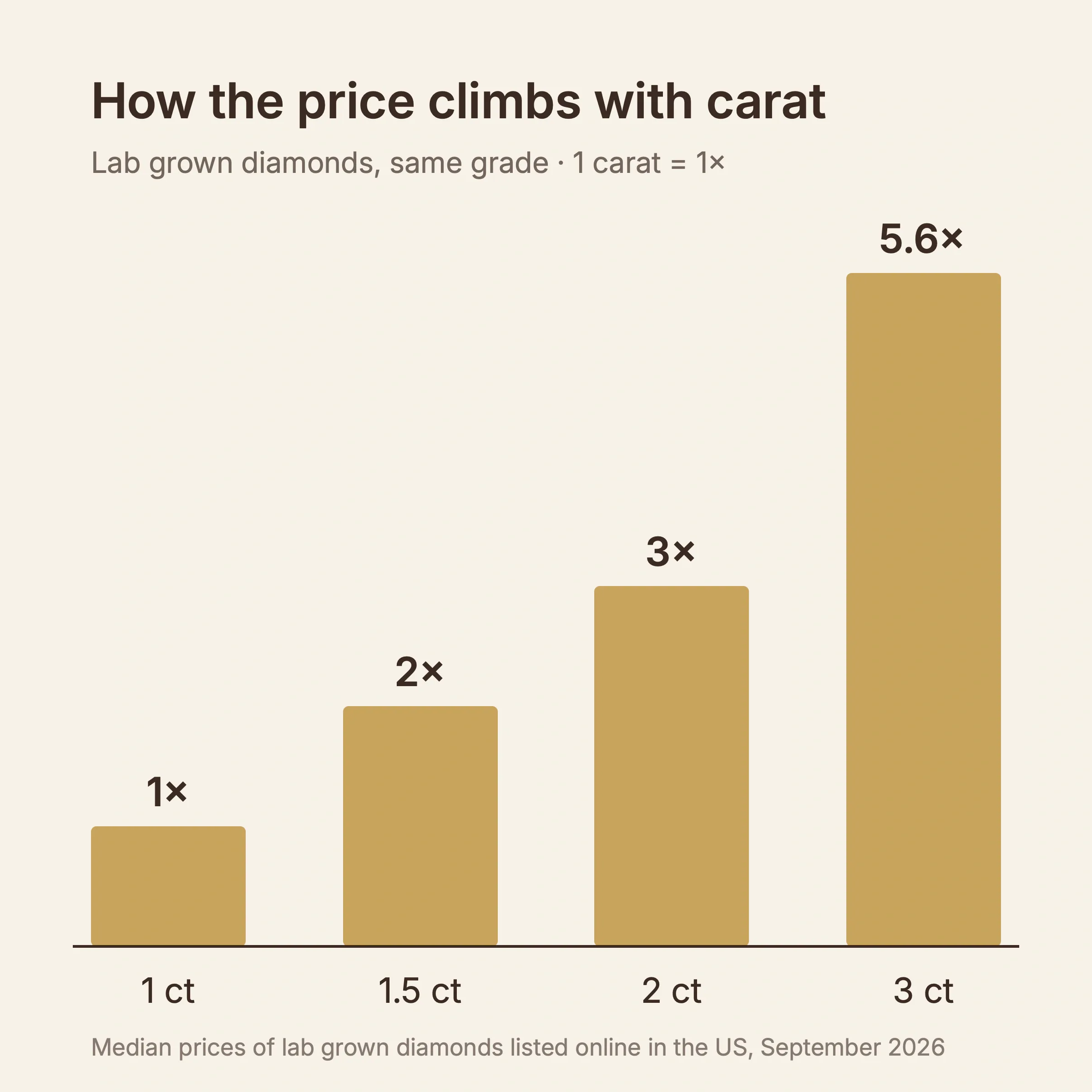
Once you have a number, the diamond decides most of what you get for it. We compared the median prices of lab grown diamonds listed for sale online in the US in September 2026, changing one thing at a time and holding everything else the same. This is what each choice does to the price:
| Choice | What it does to the price |
|---|---|
| 1 carat → 1.5 carats | About twice as much |
| 1 carat → 2 carats | About three times as much |
| 1 carat → 3 carats | About 5½ times as much |
| Round → oval, emerald, princess or cushion (1 carat) | 16% to 24% more |
| G color → D or E color, at 1 carat | About the same |
| G color → D or E color, at 2 carats | About 30% more |
| VS2 clarity → VS1, at 1 carat | About the same |
| VS2 clarity → VVS1 | About 45% more |
| 2.00 carats → just under, 1.90 to 1.99 | About 3% less |
| Mined → lab grown, at 1 carat | About 91% less |
Carat weight is the big lever. Everything else moves the price by a few percent, or by a third at most.
Getting more ring for your budget
The table points to a few choices that save money without showing.
- Don't pay for color you can't see at 1 carat. Around 1 carat, the whitest grades cost about the same as G, so there's little to gain by going lower. At 2 carats the gap opens up, and a G or H stone is where the savings are. Our guide to diamond color explains the grades.
- Stop at VS clarity. VS1 and VS2 look the same as higher grades to the naked eye, and at 1 carat they cost about the same as each other. Moving up to VVS1 adds around 45% for a difference you'd need a loupe to see. See which clarity you really need.
- Pick the shape for love, not savings. Round is the cheapest shape of the same weight and grade, but the gap to an oval or emerald is under a quarter. Which shape costs the most has the full comparison.
- Don't count on "just under" sizes. With mined diamonds, a stone just under a round number like 1 carat often costs less per carat. With lab grown diamonds the saving is small: about 3% for 1.90 to 1.99 carats against a 2 carat stone. Our 1.5 vs 2 carat guide has the numbers.
- Consider lab grown. A lab grown diamond is a diamond, and at 1 carat it lists for roughly a tenth of a mined stone of the same grade. The honest catch is resale value, which our guide on whether lab grown diamonds are worth it covers plainly.
- Choose the metal last. Platinum costs more than gold, and 18K gold more than 14K. 14K is slightly harder wearing, too.
Browse lab grown diamonds by size, from the 1 carat to the 2 carat pages, to see today's prices for each choice.
Decide together, if you can
Many couples talk about the ring before the proposal, and it takes a lot of pressure off the budget. If you'd rather keep it a surprise, you can still find out their style and size quietly. Our guide on how to propose covers the timing, including when to order so the ring arrives in time.